


I’ve been working in SEO and content writing since 2019.
Back then, my team and I had a big debate: Semrush vs. Ahrefs?
One of my colleagues pushed hard for Semrush Pro since she wanted to manage ads and dig into competitor analysis. I was on team Ahrefs since I’d already been using it for SEO and really liked it.
In the end, we went with Semrush to keep the marketing team aligned. I wasn’t too happy about it at first since I had to learn a new platform and figure out whether I could actually trust its data.
Looking back, though, it was a great experience. I ended up getting comfortable with both tools, which has been super valuable for my SEO career.
Over the years, Semrush and Ahrefs have become the best SEO tools available. They’ve rolled out new features, improved their accuracy, and updated their metrics. Still, I always remind myself their numbers are just estimates. But they’re reliable enough that I use them confidently for both my site and client projects.
In this article, I’ll compare Ahrefs vs. Semrush with real data from my website to see how accurate their numbers really are, especially if you don’t have access to Google Search Console (GSC).
I’ll also walk you through their key features for keyword analysis, content audit, site auditing, SEO analysis, SEO strategy, competitive research, rank tracking, and more.
Semrush vs. Ahrefs vs. Google Search Console
I’ve already put together a detailed Semrush review, where I compared its data with Ahrefs, Ubersuggest, and my own website numbers from Google Search Console.
I also did a deep dive into Semrush vs. Search Atlas, showing that both tools offer solid insights.
Now, let’s focus on Ahrefs vs. Semrush for my website.
You won’t find a case study like this anywhere else since most blog posts just skim the surface, which isn’t all that useful. I know my readers are already familiar with both tools, but they’re looking for a real breakdown of their strengths and weaknesses.
So, let’s get into it.
First, we’ll compare how Semrush, Ahrefs, and GSC report my site’s metrics. This should give you a better idea of how reliable these numbers are when evaluating other websites.
Here’s a quick overview of my website performance from October 2025:
| Category | Semrush | Ahrefs | Google Search Console |
|---|---|---|---|
| Organic traffic | 15,100 | 47,400 | 8,000 |
| Top 3 pages based on organic traffic | AI SEO tools Ahrefs alternatives AI marketing tools | AI SEO tools Ahrefs alternatives AI marketing tools | AI SEO tools AI marketing tools Ahrefs alternatives |
| Organic traffic estimate for the top-ranking page | 6,000 | 15,237 | 3,570 |
| Number of keywords | 3,800 | 3,350 | |
| Referring domains | 604 | 453 | |
| Number of backlinks | 2,000 | 1,300 |
Looking at the comparison table, you can see that Ahrefs’ organic traffic numbers are way off.
For August 2025, it showed my site’s organic traffic spiking to 51k—but that’s nowhere close to what I actually see in GA and GSC.
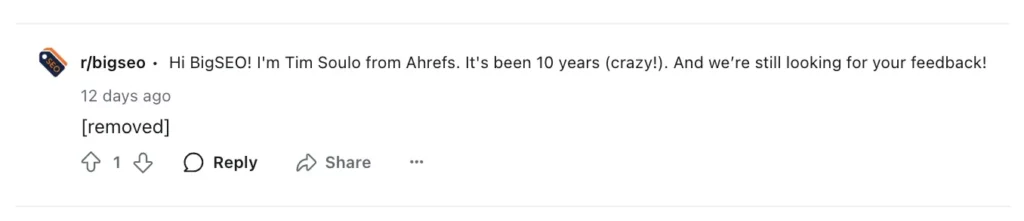
I even tried flagging this to Ahrefs’ CMO, Tim Soulo, on Reddit (where he usually asks for feedback), but my comment ended up being removed.
On the other side, both tools correctly identified my best-performing page: my AI SEO tools article. But when it comes to the top 3 or even top 10 pages, things get a little messy.
For example, Ahrefs claims my Vocal.media review is my second-best page, but GSC doesn’t even rank it in the top 5. The same goes for my SEO books page. So, if you use Semrush or Ahrefs to analyze competitors’ top pages, just know that their rankings might not be 100% accurate.
I was pleasantly surprised that both tools got the number of indexed pages almost spot on. There’s a tiny difference, but that’s likely because each tool uses different crawlers, and some take longer to find new pages. Still, when it comes to site audit metrics for indexed pages, I’d say you can rely on both tools.
One last thing before I dive into my detailed Semrush vs. Ahrefs comparison:
SEO tool metrics are just estimates. They’re great for spotting trends, whether things are improving or declining, but they’re not perfect.
For the most accurate data, Google Search Console and Google Analytics will always be your best bet. Every other tool just helps you understand the bigger picture of how your site (or your competitors’ sites) are performing.

Is Semrush more accurate than Ahrefs?
As I mentioned earlier, both tools provide estimates.
Sometimes, Semrush seems to do a better job than Ahrefs, at least in my experience, especially when it comes to rank tracking (I’ll get into that later). Both tools do a solid job of identifying keyword search intent. When I publish new pages on my site, they quickly pick them up and add them to the performance reports.
But I’ve also noticed quite a few inaccuracies in how both tools report my site’s organic performance. That makes me think their accuracy might be hit or miss for other websites, too.
Now, here is a quick note on where Ahrefs and Semrush get their data.
Semrush pulls its data from a mix of machine learning and trusted third-party sources. For rankings and keyword insights, it relies on external providers to collect Google search results for millions of popular keywords. Then, it analyzes the top 100 organic and paid positions to estimate rankings.
Ahrefs, on the other hand, has its own search crawler, AhrefsBot, that runs 24/7. They claim to rely entirely on their own database without pulling data from third parties like Google, Alexa, or Webalta.
For keyword data, Ahrefs claims to use information from Google Keywords Planner, Google Trends, Google Search Console, and other third-party data sources to find keywords, estimate their search volumes and click-through rates.
Semrush vs. Ahrefs comparison
Alright, let’s dive into how these two tools compare based on their key features.
I’ll be honest, I have a paid Semrush Pro plan ($139.95/m) and the Ahrefs Starter Plan ($29/m). But if you try to decide which one is right for your business, it really depends on your goals.
Ahrefs could be great if you purely focus on SEO, but it doesn’t have local SEO features.
Semrush, on the other hand, is an all-in-one marketing solution with 55+ tools for SEO, PPC, social media, content marketing, local SEO, site audit tool, market research, and competitor research. That’s a lot! But with all those features, it can feel a bit overwhelming at first.
One thing to keep in mind is that Semrush has different pricing for different toolkits depending on your needs.
For example:
- Semrush SEO Toolkit — Starts at $139.95 per month for the Semrush Pro plan
- AI Visibility Toolkit — $99 per month
- Traffic & Market Toolkit — Starts at $289 per month
- Local SEO Toolkit — Starts at $30 per month for the Base plan
- Content Toolkit (former Contentshake AI) — $60 per month
- Social Media Toolkit — Starts at $20 per month for the Base plan
- Advertising Toolkit (for PPC data)— Starts at $99 per month for the Base plan
- Semrush One — Starts at $199/m for an SEO + AI Visibility toolkits.

For keyword research
Now, let’s take a closer look at the Semrush and Ahrefs features.
Semrush and Ahrefs both offer powerful keyword research tools, making them top choices for SEO professionals.
However, it’s worth mentioning that Ahrefs’ overall keyword database is bigger (as of August 2025), but Semrush provides more keyword variations for the USA, if that’s your target location.
- Semrush keyword database: 27.3 billion keywords in 142 locations, 3.7 billion keywords in the USA alone
- Ahrefs keyword database: 28.7 billion keywords in 217 locations, 2.2 billion keywords in the USA alone
What this means for you is that Ahrefs will potentially be able to identify and show you more keyword opportunities. However, Semrush can offer you more keyword opportunities specifically for the USA.
These numbers can change anytime since both tools always update their databases. That’s why I’ll be checking Ahrefs’ Keyword Explorer page and Semrush’s stats occasionally to keep my article up to date.
From what I’ve seen, these reports offer similar insights and help with keyword research in pretty much the same way:
Semrush
- Keyword Overview: Breaks down keyword metrics and shows keyword variations.
- Keyword Gap Analysis: Helps you compare your keyword strategy with competitors.
Ahrefs
- Keyword Explorer: Provides keyword metrics and suggests variations.
- Keyword Gap Analysis: Lets you see how your keyword game stacks up against competitors.
If you’re looking for even more keyword ideas, check out Semrush’s Keyword Magic Tool. It’s a powerful keyword generator that pulls up thousands of keyword suggestions based on your topic.
Personally, this is my go-to tool for keyword research for my site and clients. I talked more about it in my Semrush review.
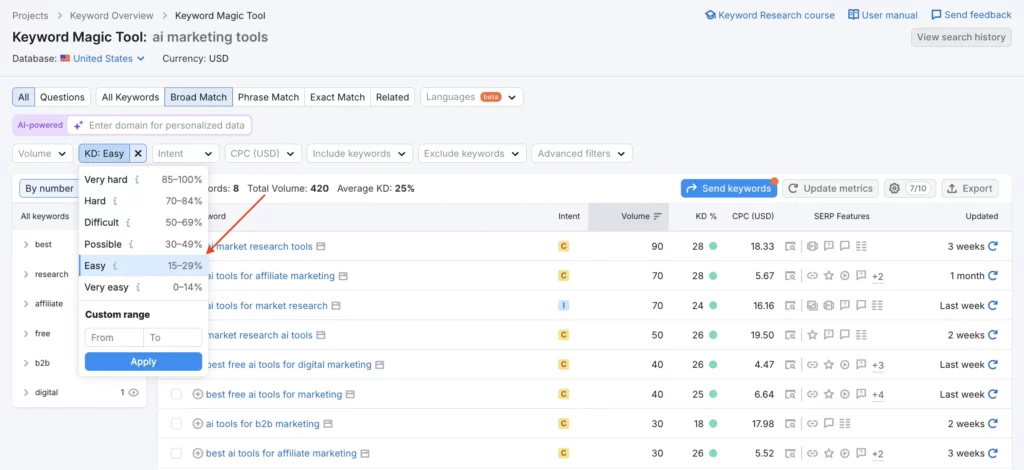
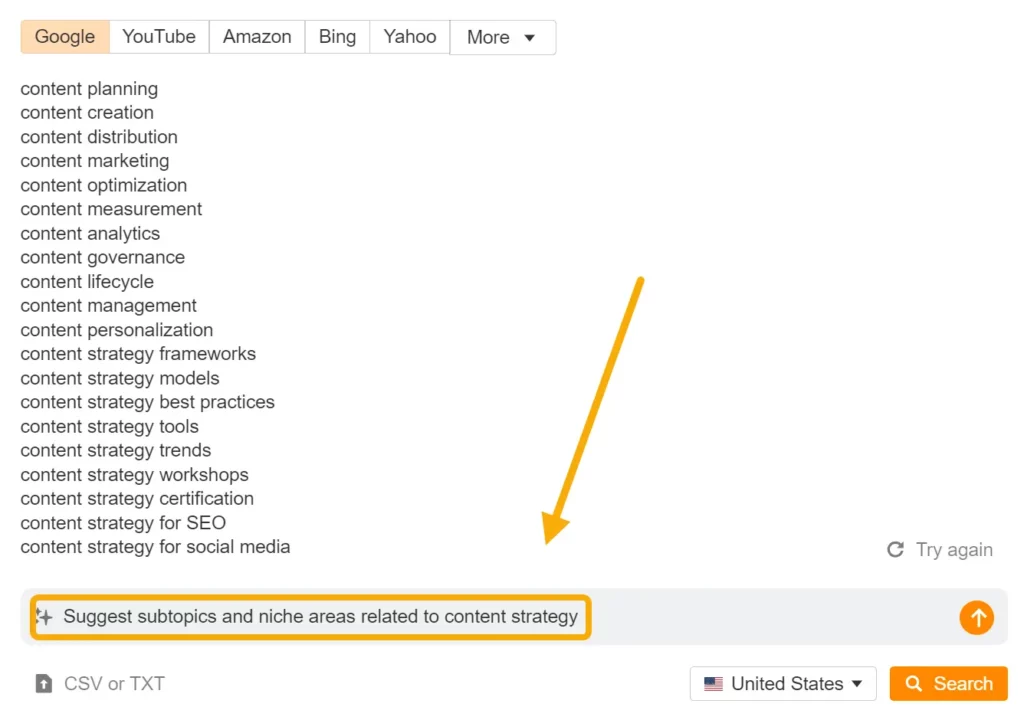
Ahrefs recently rolled out an AI tool to help you find keyword ideas. But honestly, it feels more like a general AI tool than a dedicated keyword research tool. That’s why I still prefer Semrush’s Keyword Magic Tool for the job.
Here’s a sneak peek at Ahrefs’ AI-powered suggestions inside Keywords Explorer:
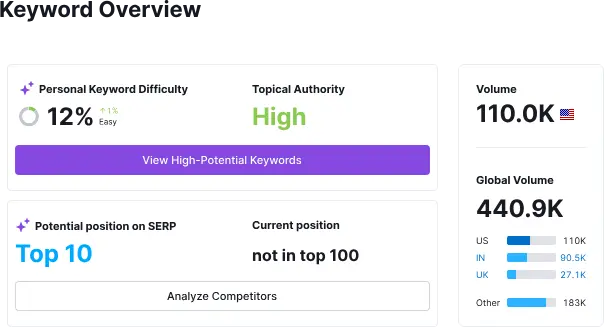
Semrush recently rolled out a new feature called personalized AI-powered insights.
Basically, it gives you keyword suggestions tailored to your website by considering things like keyword difficulty, your domain authority, and how relevant the keyword is to your content. It feels like niche keyword research just got a serious upgrade!
Overall, both tools come with powerful keyword research features.
As an SEO specialist and content writer, I’ve extensively used their keyword data to grow my own site and support my clients.
Nowadays, my website has about 100 indexed pages and brings in over 11,000 visitors a month—all thanks to the SEO content strategy I built using Semrush and Ahrefs.
For search rankings tracking
Keeping an eye on keyword rankings is a must for anyone doing SEO. That’s where rank tracking tools come in. They can help you stay on top of your rankings and notify you if any important organic keywords start losing their positions.
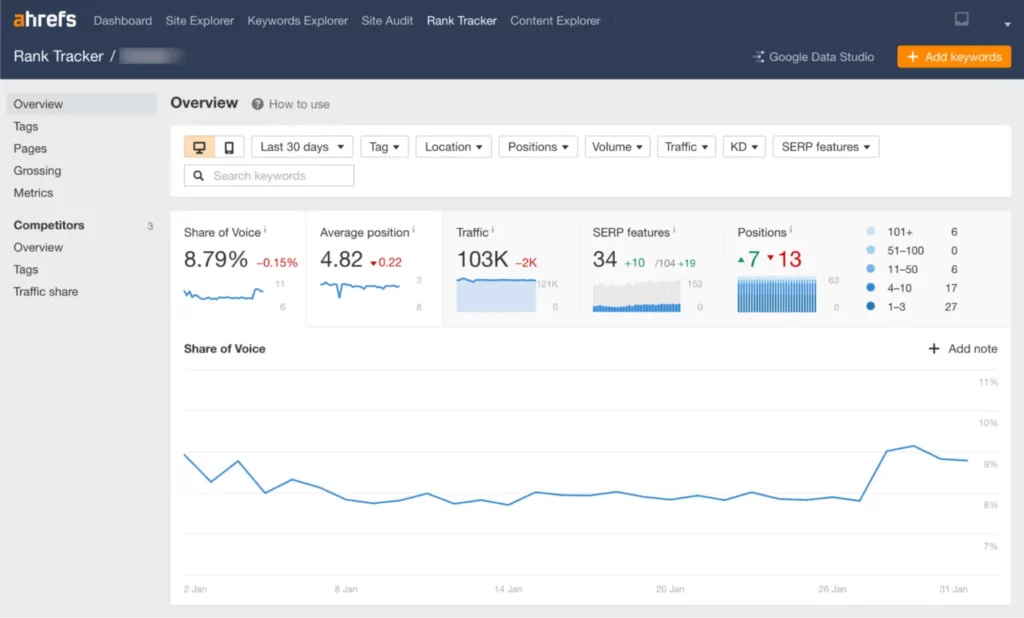
Ahrefs Rank Tracker makes it easy to track your Google rankings, including SERP features, on both desktop and mobile across 190 countries.
But keep in mind that this feature is paid. It’s not included in the Ahrefs Webmaster Tools account, which is available for verified websites for free.
If you run a small site, you can start with Ahrefs’ Starter Plan, which lets you track 40 keywords for $29. If you need more, the Lite Plan offers tracking for up to 750 keywords with weekly updates.
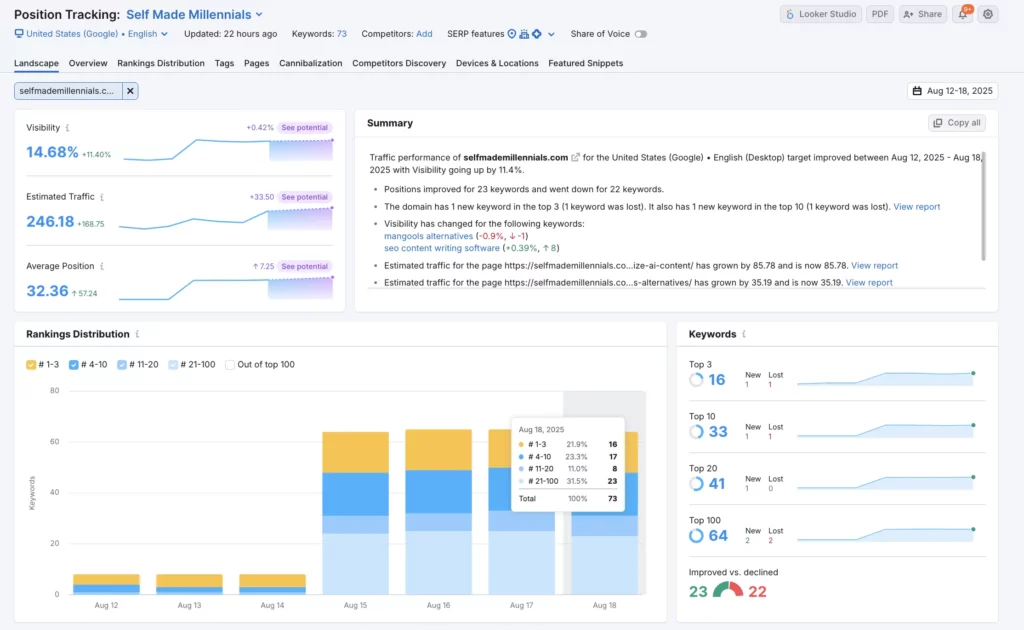
Unlike Ahrefs, Semrush provides you with fresh updates daily, so you can immediately spot ranking changes. On top of that, you can track ranking positions for up to 8 keywords for free, using Semrush’s free plan (I know it because I do it).
With Semrush Pro, which is $139.95, you can track up to 500 keywords with daily updates.
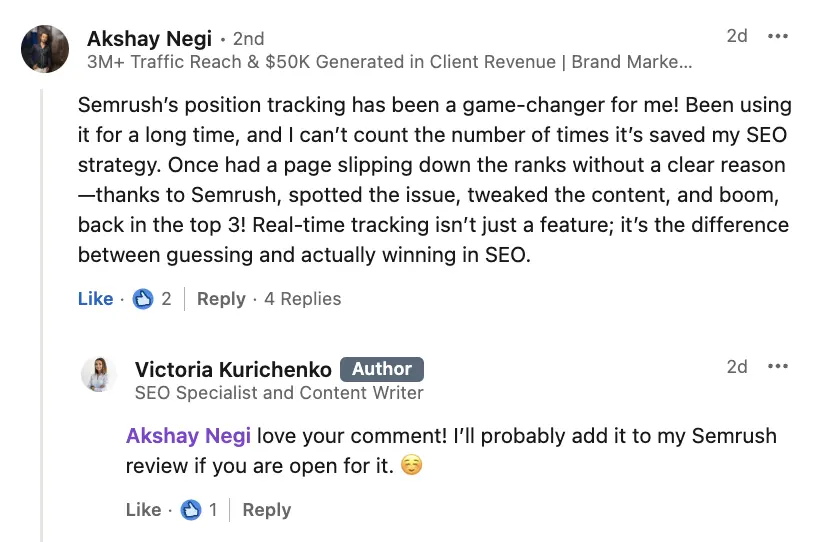
Here’s what Akshay Negi, a brand marketing expert, says about using Semrush’s Position Tracking tool to boost his online business:
For backlink analysis
Before we dive into the details, let me give you a quick rundown of the backlink data these tools have:
- Semrush backlink database: 43 trillion backlinks and 390 million referring domains
- Ahrefs backlink database: 35 trillion backlinks and 500 million referring domains
These numbers are as of August 2025, but I’ll update them if Semrush or Ahrefs releases new stats.
Alright, now let’s get into the Ahrefs vs. Semrush showdown.
According to Backlinko, Ahrefs was first launched in 2011 as a backlink checker and analyzer tool.
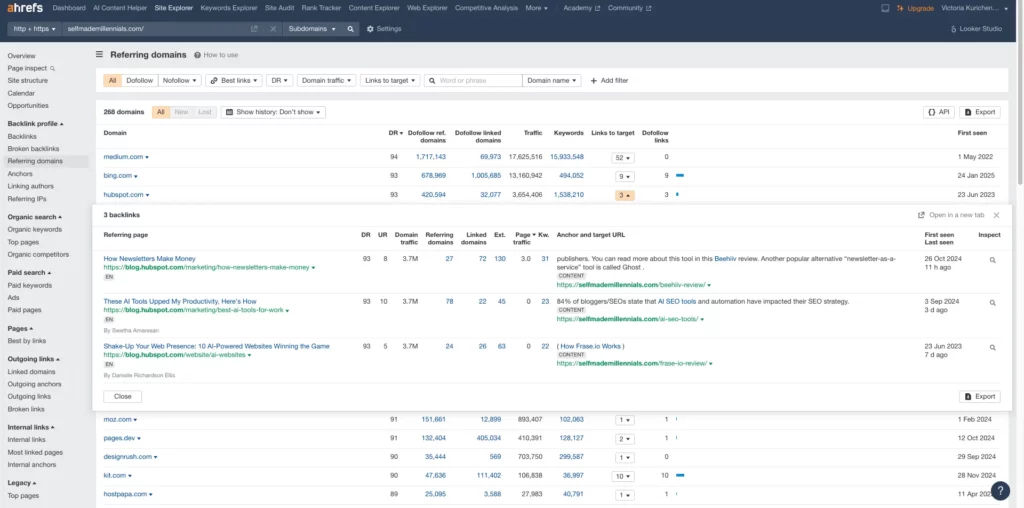
Ahrefs’ backlink reports are easy to follow, making it simple to analyze backlinks, referring domains, and anchor texts (the clickable text in a link).
It also has two unique reports that I haven’t seen in Semrush:
- Broken backlinks – It shows if a website or URL has broken backlinks pointing to it.
- Linking authors – It reveals which authors frequently link to your and your competitors’ content.
The broken backlinks report is a goldmine for link-building strategies.
Back in the early days of my website, I used it to find broken links and reached out to site owners, asking them to replace those with my links. And those high-quality backlinks are still live today!
The linking authors report can be super useful for startups and brands trying to boost their authority. If reputable authors are linking to your competitors, why not reach out? You could hire them or pitch them a guest post to get on their radar.
In addition to offering a backlink analysis toolkit, Semrush provides a dedicated tool for outreach experts — Link Building Tool.
So, if your task is to build backlinks, this tool can save you time by finding link building opportunities for your domain.
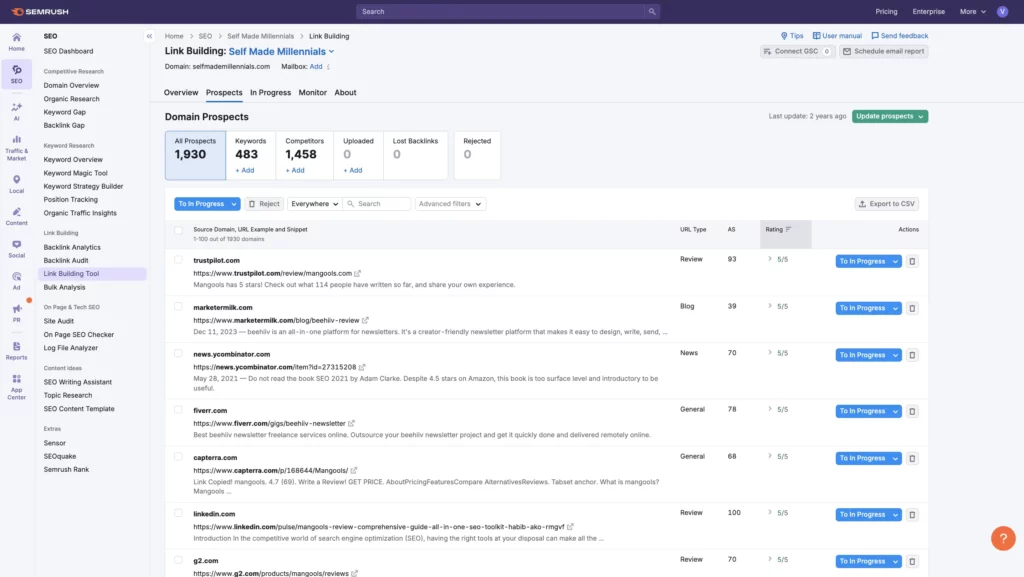
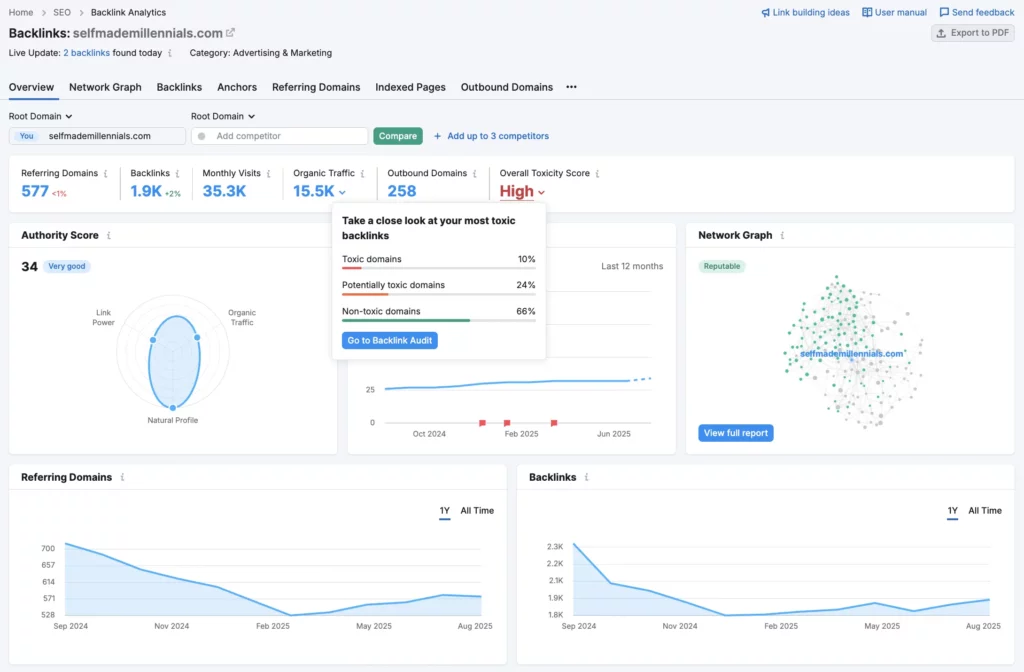
I like the way Semrush’s backlink analysis tool works. There are about 16 different reports under Backlink Analytics. It gives you a full picture of your backlink profile from different angles.
For example, Semrush flags about 10% of my backlinks as toxic. But at the same time, it says my backlink profile looks natural, which makes sense since I’ve never bought backlinks and never used guest posting.
As a result, my website’s authority score keeps going up over time!
Unique features and metrics
After using both Semrush and Ahrefs extensively, I’ve put together the following breakdown of their unique features and metrics.
This is valid for August 2025, but the tools might implement new solutions at any time. Therefore, I’ll try to keep this list up-to-date.
Semrush SEO Toolkit’s unique features and metrics
- Total traffic from all channels – You can see traffic from organic, paid, social, and referral sources.
- Traffic Share – It’s a new metric displayed in the Domain Overview report that helps you find out which websites dominate in your niche.
- Toxic Score – It shows how toxic your backlink profile is. These are backlinks from websites with low authority that could hurt rankings.
- SEO Content Template – You can use this feature to automate the creation of SEO content briefs.
- SEO Writing Assistant – It’s a helpful feature that I highly recommend using to optimize your content with real-time SEO suggestions.
- Share of Voice (SoV) – This metric helps you measure your brand’s visibility against competitors.
- Authority Score – This metric measures the domain’s reputability. It accounts for the number and quality of its backlinks, organic search traffic, and overall authenticity of its profile.
- EyeOn competitor monitoring – This is one of my favorite features. It monitors your competitors’ online marketing activity 24/7 and sends you alerts with updates.
- On-page SEO Checker — It provides you with content ideas based on competitive analysis that can help you improve the organic performance of your website in search engines.
Ahrefs’ unique features and metrics
- Parent Topic – This metric shows if you can rank for your keyword while targeting a more general topic instead.
- Traffic Potential – This metric helps you estimate how much traffic a keyword can bring to your website if ranked #1.
- Return Rate (RR) – This metric shows how often people search for this keyword again in a 30-day period.
- Clicks Per Search (CPS): Not every search turns clicks. This metric shows the average number of clicks per search.
- Best by Links’ Growth –This feature helps you identify pages gaining backlinks the fastest.
- WordPress SEO plugin – This is a helpful feature for websites powered by WordPress. It helps analyze existing content and provides optimization recommendations directly within WordPress.
It may seem like Semrush wins this race because it has more unique features. But I think both tools are powerful and can be helpful depending on your needs.
Semrush is great for an all-around marketing approach, while Ahrefs is great for deep SEO insights and backlink tracking.
It all depends on what you need!
Semrush vs. Ahrefs: AI content tools
After ChatGPT took off, both Semrush and Ahrefs jumped on the AI train to give their users even more ways to get things done.
These days, both platforms have rolled out a bunch of AI-powered tools, especially for content generation and humanizing AI content.
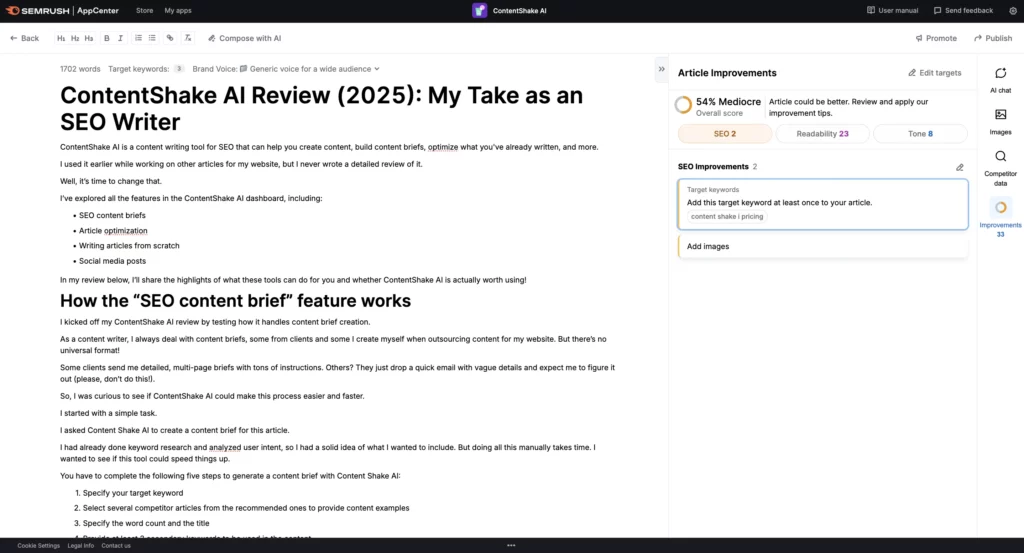
For example, Semrush Content Toolkit (formerly Contentshake AI) automates nearly the entire content process, from content brief creation to content generation and optimization.
I actually wrote a deep-dive review of ContentShake AI if you want to check it out. Just a heads-up: you’ll need to pay an extra $60/month to use it.
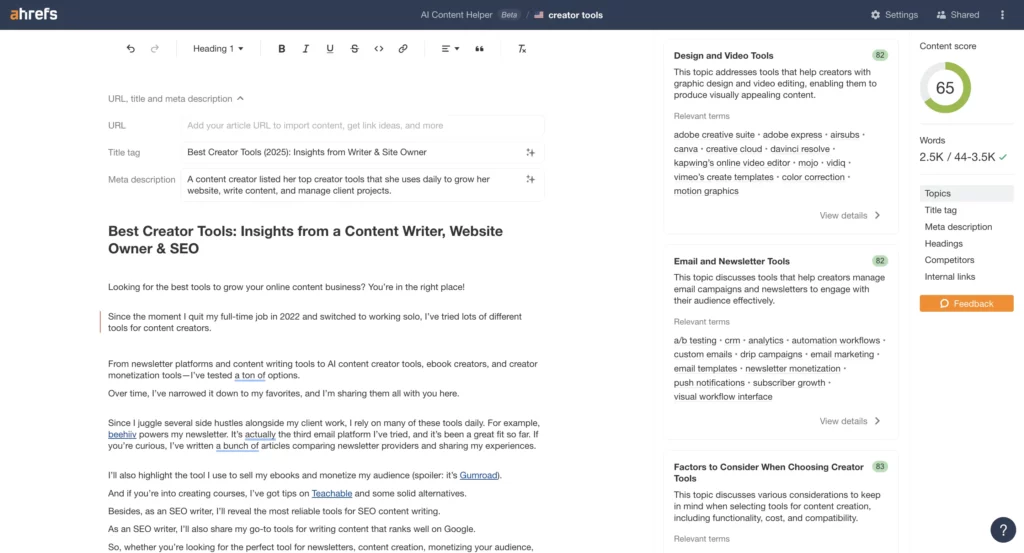
Ahrefs has also launched its AI Content Helper, similar to Semrush’s Content Toolkit, but powered by Ahrefs’ own data. The idea is to help you optimize your content for rankings by considering search intent and related terms.
It also has AI-generated meta titles and descriptions to make your life easier. The tool itself is pretty straightforward, nothing too fancy, but it gets the job done.
Note that it’s an add-on that costs $99/month for 50 documents. Personally, I think that price is a bit high, especially when there are more budget-friendly options out there.
Besides paid AI solutions, Ahrefs offers tons of free AI tools for writing, SEO, content marketing, social media, and business.
Here are a few tasks that you can do with Ahrefs’ free AI writing tools:
- Generate blog post ideas
- Generate meta titles and descriptions
- Generate blog post outlines
- Rewrite and paraphrase content
- Optimize your content
- Summarize articles
- Expand or shorten the text
- Improve grammar and clarity
- Generate FAQs
- Create social media captions
- And more
Pricing
Both Semrush and Ahrefs are paid tools that have always been quite expensive.
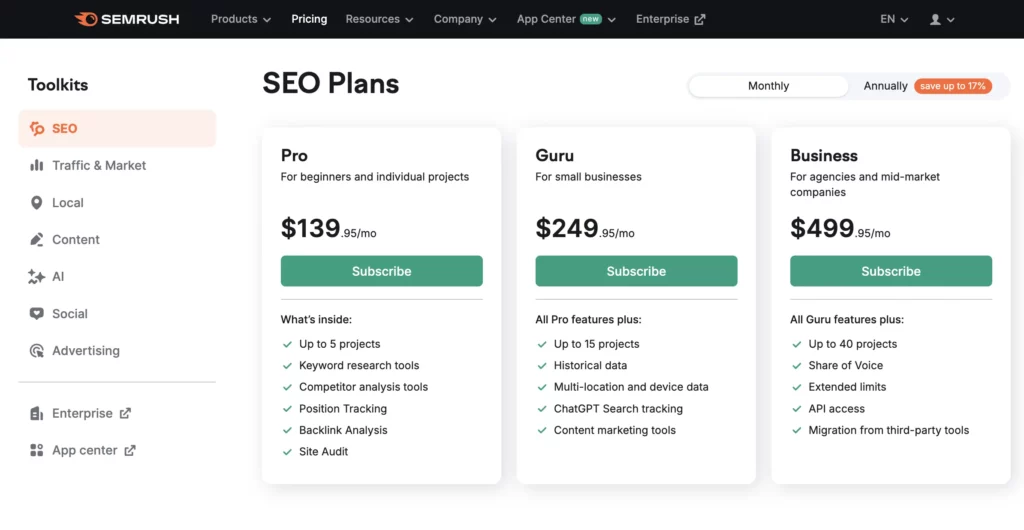
Semrush pricing starts at $139.95 per month for Semrush Pro. This paid plan lets you manage 5 domains and can be suitable for SEO freelancers managing up to 5 clients and site owners.
For agencies managing 10+ domains, there are the Semrush Guru Plan or Business Plan.
Normally, Semrush provides only a 7-day free trial, but my readers can benefit from an extended 14-day free Semrush SEO Toolkit trial and a 14-day Semrush One trial since I’m a Semrush partner. Just a small way to get more time to explore and see if it’s a good fit!
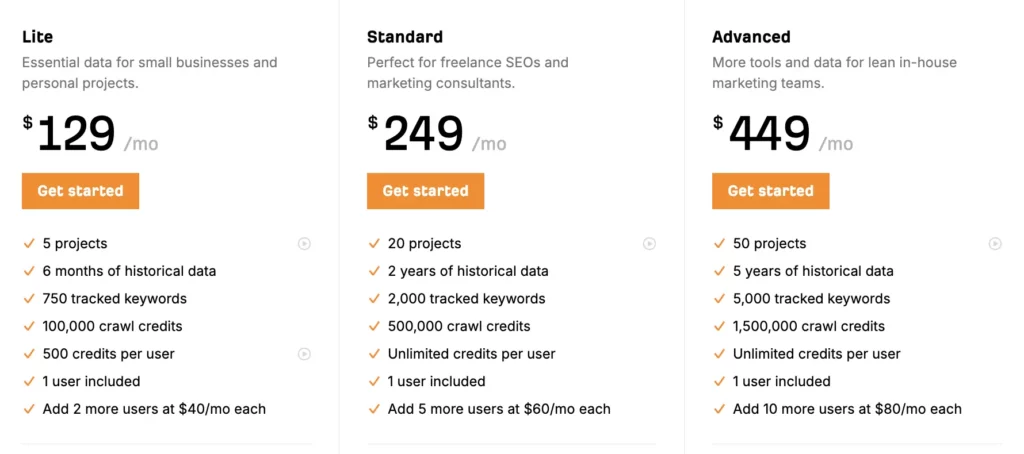
Ahrefs pricing starts at $129/month, which gets you access to 5 domains and 500 credits (one credit = one action). Be careful, though, those credits disappear fast! If you run out, you’ll have to buy more to keep using the tool.
According to Ahrefs, credits get consumed when accessing reports and requesting new data from:
“Most core tools: Site Explorer, Keywords Explorer, Content Explorer, Web Explorer, Competitive Analysis
Standalone tools: Batch Analysis, Looker Studio (Site Explorer only), Page Inspect
Site Audit and Rank Tracker DO NOT consume credits. They have their own limits.”
Personally, I find the credit system annoying, but I still use Ahrefs from time to time because I like their features, and their customer support team is responsive.
If you’re on a budget, Ahrefs offers free Webmaster Tools, which gives verified website owners (verified via Google Search Console) limited access to Site Explorer and Site Audit.
My go-to Ahrefs plan is the Starter plan at $29/month. It includes Site Explorer, Keywords Explorer, and Site Audit, which makes it perfect for beginners, startups, and solopreneurs looking for an affordable SEO solution.
My take: What’s better, Semrush SEO Toolkit or Ahrefs?
I use Semrush SEO software for client projects because it’s an all-in-one marketing tool, not just for SEO but for everything from PPC to content marketing. It gives me a full suite of features to work with.
For my own website, though, I occasionally subscribe to the Ahrefs’ Starter Plan at $29/month. It’s budget-friendly and still gives me the key features I need for keyword research, rank tracking, competitor analysis, and backlink monitoring.
If you decide between Semrush and Ahrefs, start by figuring out your SEO needs first and your monthly budget.
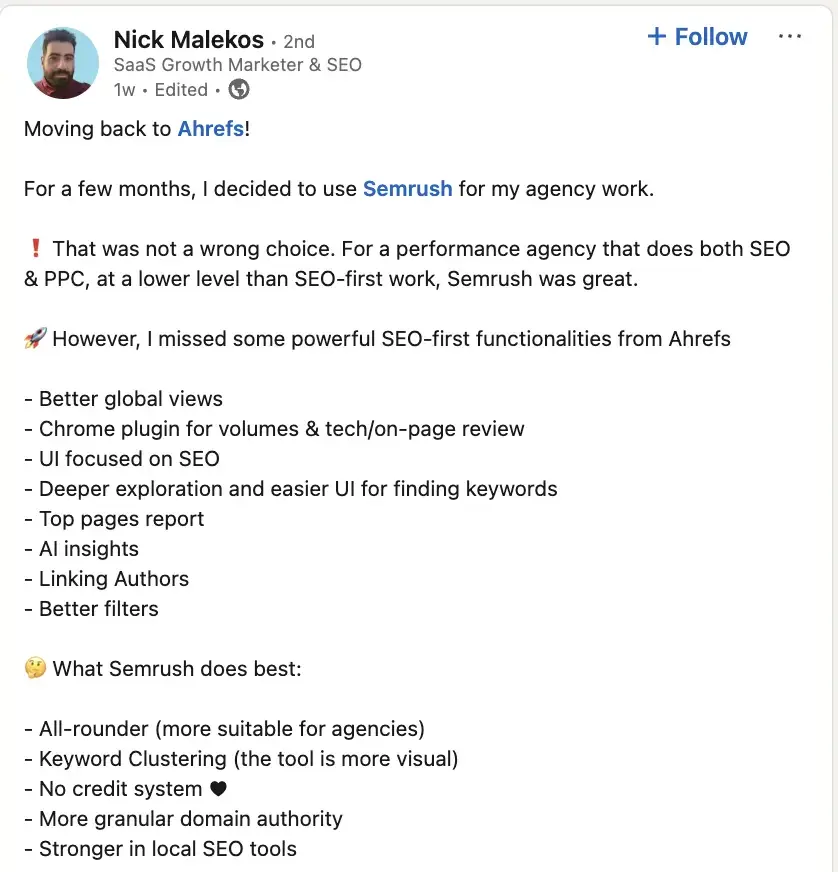
I like how Nick Malekos, a SaaS growth marketer, breaks down his thought process when choosing between Ahrefs and Semrush. He highlights the pros of both, but ultimately goes with Ahrefs because it fits their needs.
If you’ve been thinking about trying Semrush Pro, here’s a little perk—my partner link gives you a 14-day free trial to Semrush SEO Toolkit and a 14-day free trial to Semrush One instead of the usual 7 days.
Just a small way to get more time to explore and see if it’s a good fit!

Join the newsletter for actionable SEO tips, case studies, and a behind-the-scenes look at my affiliate marketing journey.
No spam. Unsubscribe anytime.

0 Responses
Hi,
Many people use Ubersuggest because it is cheap.
Is it worth compared to Semrush and Ahrefs?
If I am paying for a tool at least I want to use one that is in a way accurate.
Is it possible that ahrefs tracks Bing as well as organic search or just Google?