


In November 2022, OpenAI launched ChatGPT, and that moment basically kicked off the AI era.
Back then, none of us really understood how it would change our lives, both at work and at home. But now that more than three years have passed, I can honestly say ChatGPT has completely changed the way I work and how I search for information online. And it still feels too early to make a final call on its long-term impact.
In October 2024, Google rolled out AI Overviews in over 180 countries.
I still remember that day so clearly: I was working on an SEO project for a client, doing keyword research for an article, when I spotted something different in the search results. Google had quietly launched AI Overviews in Canada.
My first thoughts were:
- How much will organic traffic drop?
- Will search habits shift overnight?
- Is running a website still worth it?
And honestly, my gut was right — AI Overviews quickly became the go-to place to get answers to almost any question without clicking through to a website. Over time, Google kept experimenting with how AI Overviews looked and how much space they took.
In my opinion, tracking organic keyword rankings is becoming more and more pointless because even if you’re “Ranking #1,” your page might still be pushed way down the page below AI Overviews, ads, and all those featured snippets.
In my opinion, Google is stealing traffic, and it doesn’t plan to stop any time soon (I talk more about this later in the article).
And do you remember when the AI Mode was introduced in March 2025? Not sure about you, but I never switched to it instead of regular search. Still, everyone keeps talking about “ranking in AI Mode” as if it’s already a huge deal for SEO. Maybe it will matter one day, but right now, no one really knows.
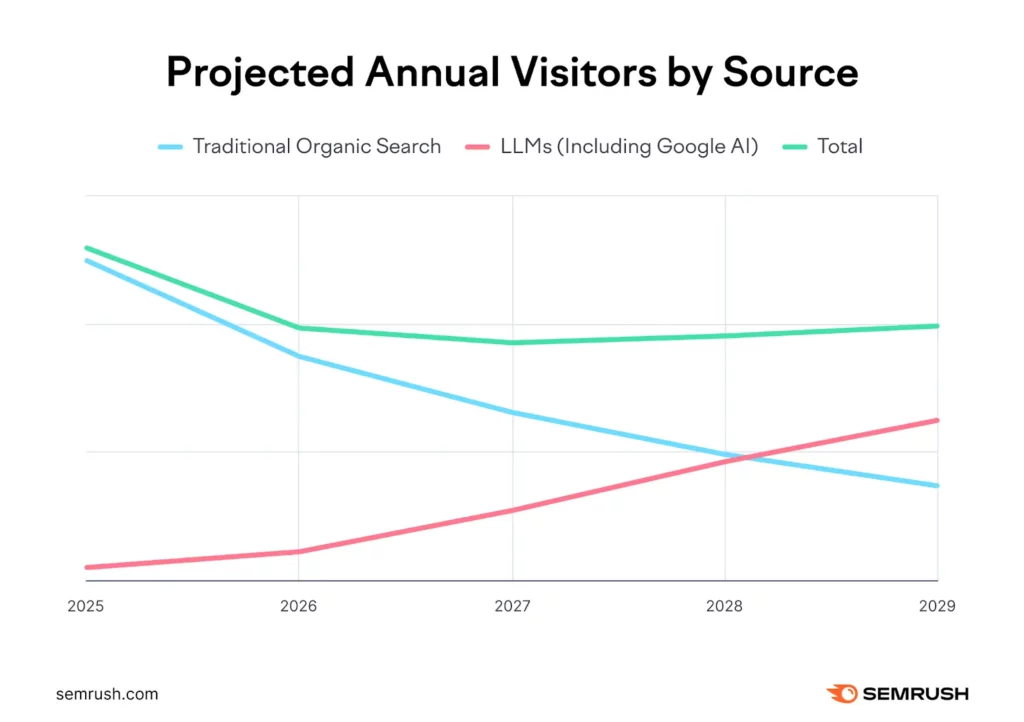
Semrush, in its recent AI search study, mentioned that AI search visitors might surpass traditional search visitors by 2028, which is a pretty strong reminder to keep an eye on AI trends and update your strategy if you want to stay in the game.
AI and SEO Tends 2026
In this article, I’m sharing my take on how the whole SEO landscape is shifting, how AI is influencing SEO, what we as SEOs can do to get ready, and which AI-driven trends we’ll likely see in 2026.
Buckle up! This piece is based on years of my experience as an SEO specialist and exclusive insights from top industry experts, like Aleyda Solis, that I gathered at an SEO conference in Toronto last October.
Curious about where we are now and what’s coming next in the world of AI SEO? Let’s dive in!
1. E-E-A-T is at the core of AI SEO
E-E-A-T stands for Experience, Expertise, Authoritativeness, and Trustworthiness.
This concept comes from Google’s Search Quality Evaluator Guidelines, and it helps Google understand whether your content is reliable and high-quality.
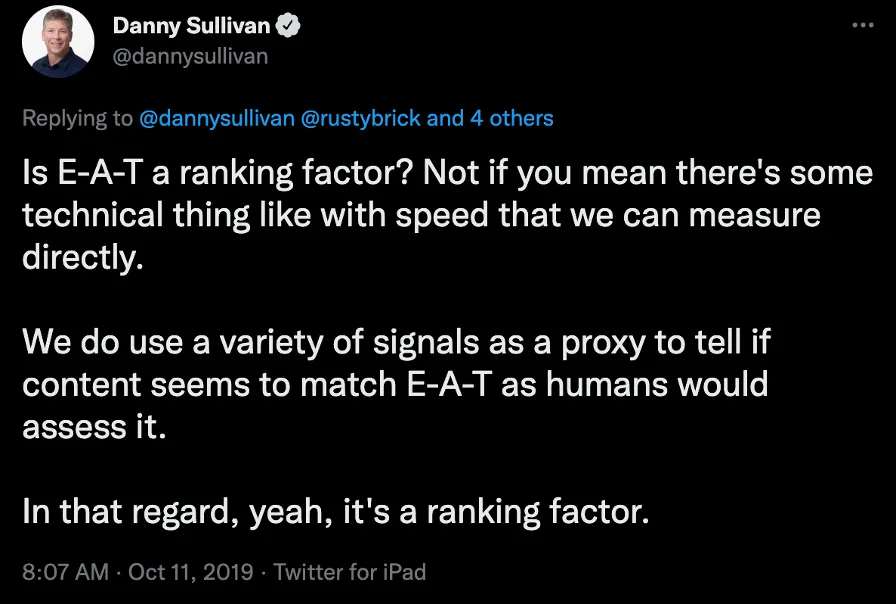
Even though Google says E-E-A-T (which used to be E-A-T) isn’t a direct ranking factor, Danny Sullivan, Google’s Public Liaison for Search, has made it clear that Google still uses it as a way to measure how helpful content really is.
From my perspective as an SEO expert, E-E-A-T will be one of the most important things to consider when conducting niche keyword research and planning an SEO content strategy for 2026.
Whether you use content writing tools for SEO or write everything yourself, the most important thing is creating content that actually meets user intent and aligns with E-E-A-T.
I believe that more creators and brands will start focusing on content that includes unique insights and personal experience.
This probably means we’ll see fewer faceless articles and more content created together with people who actually have real, hands-on knowledge.
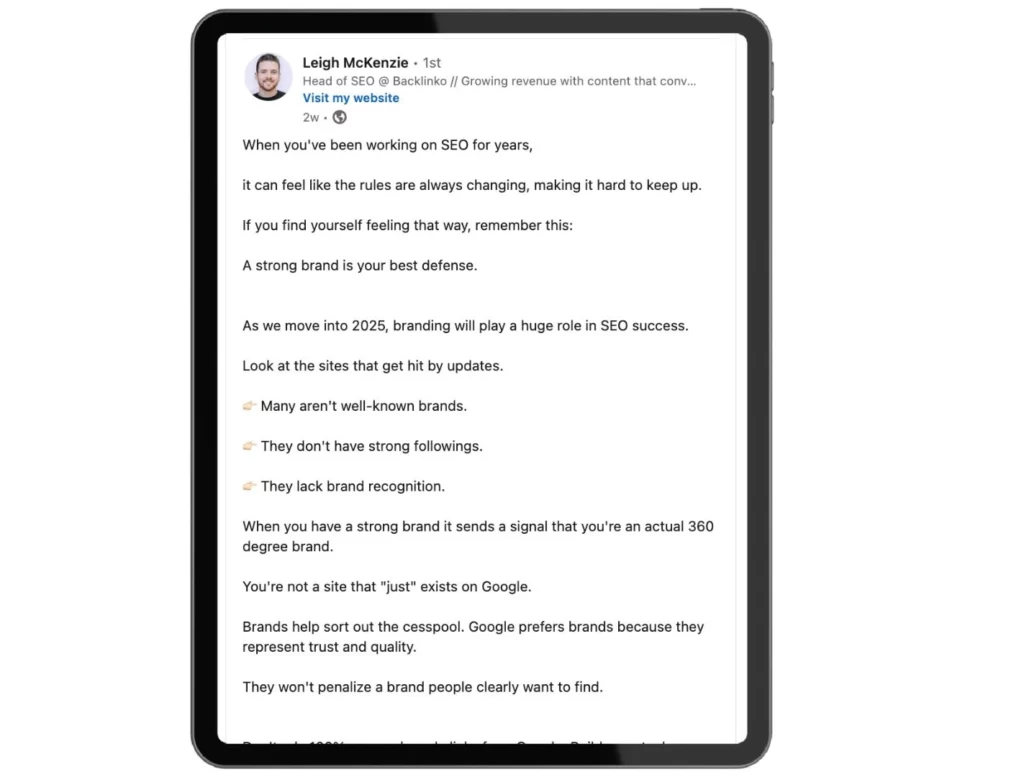
So what’s the best way to make sure your website aligns with E-E-A-T? Build a personal brand or a strong corporate brand.
Leigh McKenzie, Head of SEO at Backlinko, puts it perfectly:
2. Focus on topical authority
Topical authority means narrowing down the topics you write about and going deep instead of wide, covering one or a few niches fully and holistically.
It’s about choosing to become a go-to expert in one specific topic instead of spreading yourself thin across dozens of categories.
This helps your website become the main place users go when they want information about your niche, and it also positions you as an actual opinion leader.
And now, with AI making content creation cheap and easy for everyone, we’re moving toward a world where only reputable websites with strong topical coverage will keep getting visibility. Everything else will slowly fade away before it even reaches users.
Websites that go wide instead of deep are already losing their spots to smaller or newer sites with stronger topical authority.
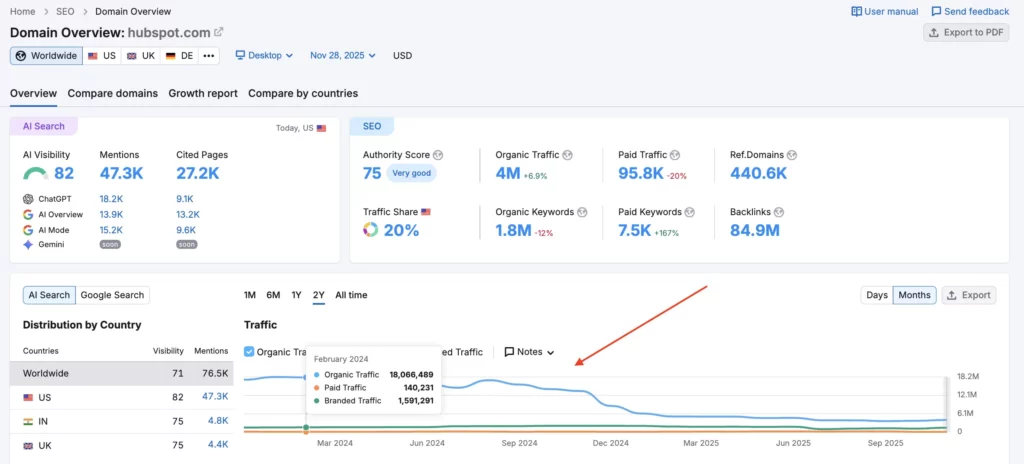
You’ve probably heard what happened to HubSpot after Google’s update — the one that started prioritizing topical authority over domain authority, since backlinks can be manipulated.
HubSpot went from 18 million to 4 million monthly visits in just two years… and never recovered.
Honestly, I think this shift is a good thing. A lot of traffic that big players like HubSpot used to capture is now going to sites that (hopefully!) deserve it more.
I feel lucky because I’ve been building both my personal brand and my site’s topical authority for years.
Everything on my website connects to SEO writing, SEO tools, and SEO resources. I also share my hands-on experience with side hustles for writers, since that’s how I started, and I have a lot to say. But mostly, you’ll hear me talk about content SEO and SEO tools.
And I can clearly see how that helps my site stay stable whenever Google shakes things up. My website still ranks for competitive keywords even without a strong backlink profile.
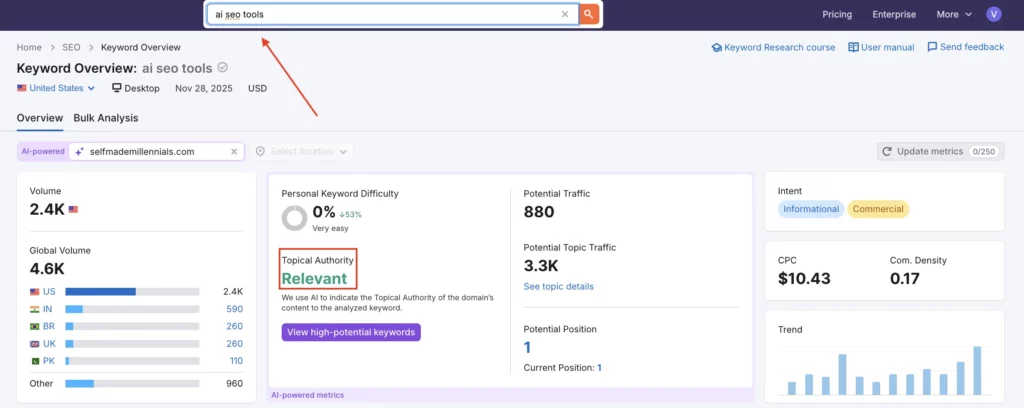
In the example below, you can see that my site is already associated with many AI SEO-related keywords. Semrush’s Keyword Overview + AI Assistant helps show whether a keyword can strengthen your site’s topical authority.
This tool is part of the Semrush SEO Toolkit, in case you want to check it out.
3. Citations are new backlinks
Citations are linked references to specific sources or webpages that ChatGPT, Google AI Overviews, or Google AI Mode use when generating an answer.
Tim Soulo mentioned something on one of the Ahrefs Podcast episodes that really stuck with me because it’s becoming a real trend:
It’s a brilliant way to describe what’s happening.
Let me explain.
Backlinks used to act like “votes” from one website to another, signaling to search engines that the content was useful and worth linking to.
More backlinks = higher domain authority = better chances of ranking for competitive keywords.
But this traditional model has shifted with the rise of AI.
AI citations can appear outside of regular search results, in LLMs and AI Overviews, giving your brand more exposure and more potential clicks.
The challenge is that there’s no clear algorithm explaining how to earn citations in LLMs or AI Overviews. These results depend heavily on third-party content and user reviews.
Still, you can improve your chances by publishing citation-worthy content, strengthening your brand reputation, making your content accessible to AI crawlers, following SEO best practices, and setting up a product feed.
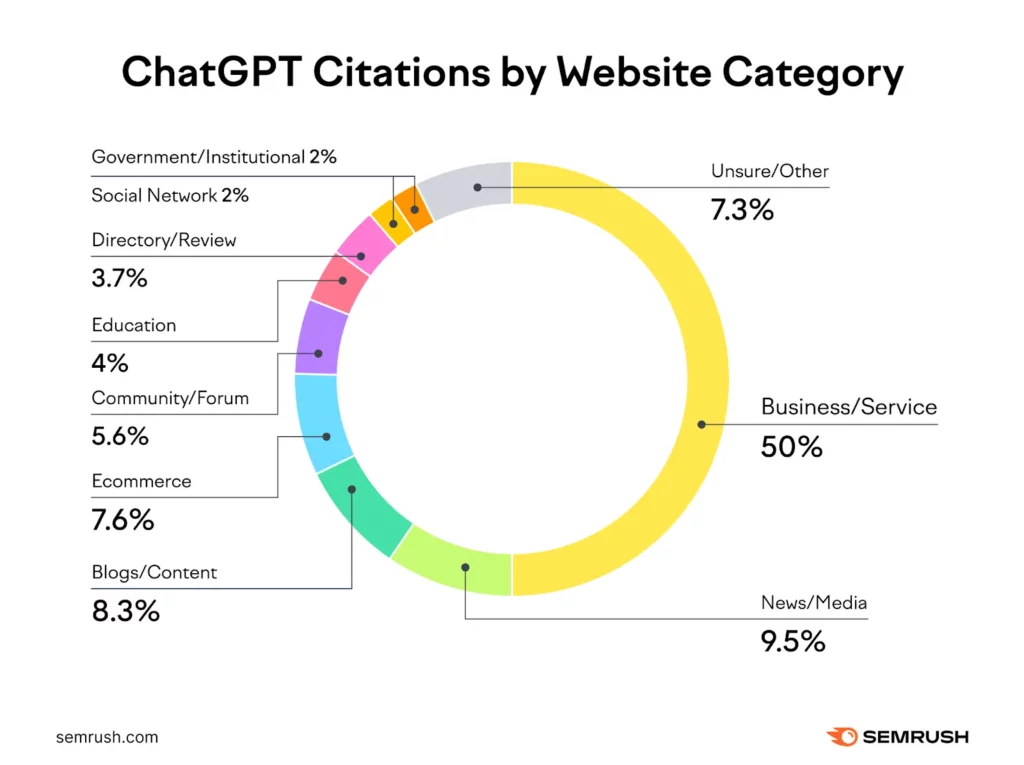
According to Semrush, almost 60% of AI citations in ChatGPT come from business/service sites and media sites, which means there’s a lot of potential for websites like yours to get cited.
4. SEO becomes multichannel
Gartner analysts predict that by 2026, traditional search engine volume will drop by a whopping 25% due to AI chatbots and other virtual agents.
Long-term, this means we’ll likely see less organic traffic from search engines.
But it also means the user journey becomes more complex. People will rely on platforms like ChatGPT, Perplexity, Gemini, TikTok, Reddit, LinkedIn, and more to find answers.
And as you know, brand mentions across third-party platforms help increase AI citations, which is now a huge part of AI SEO.
So if you manage your brand presence across the web, there’s a much higher chance that LLMs and AI Overviews will show accurate information about your brand.
The big question for content creators in 2026 will be: How do you create different types of content and decide where to distribute it?
If you’re a content creator, my advice is to stick to the channels where you feel most comfortable showing up. For me, that’s Medium, LinkedIn, and Reddit because I love writing.
But if you’re a business, you can’t afford to skip the platforms where your users are spending time.
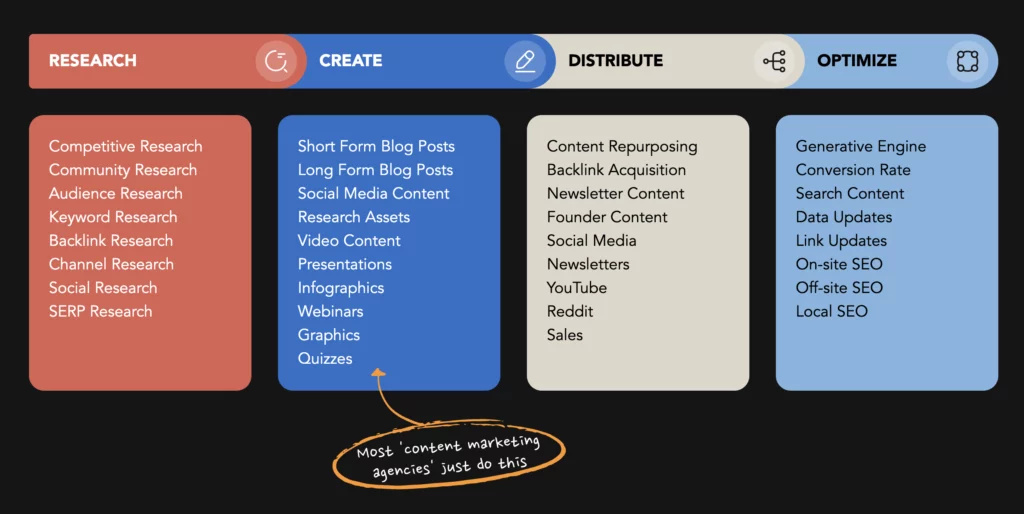
At the conference, Ross Simmonds, founder and CEO of Foundation Marketing, walked us through their Content Growth Framework. It breaks down the entire content creation and distribution process.
For me, Ross’s presentation was all about speed and scale: how to turn one piece of content into many, and how to adapt each version for different channels.
What used to take hours manually now takes a fraction of the time if you know how to use AI well.
5. AI automated workflows for SEO
I’m already seeing SEO teams experimenting with fully automated workflows for tasks that used to take a ton of time and resources, like:
- Fully automated content production
- Fully automated SEO strategies built entirely from client input data
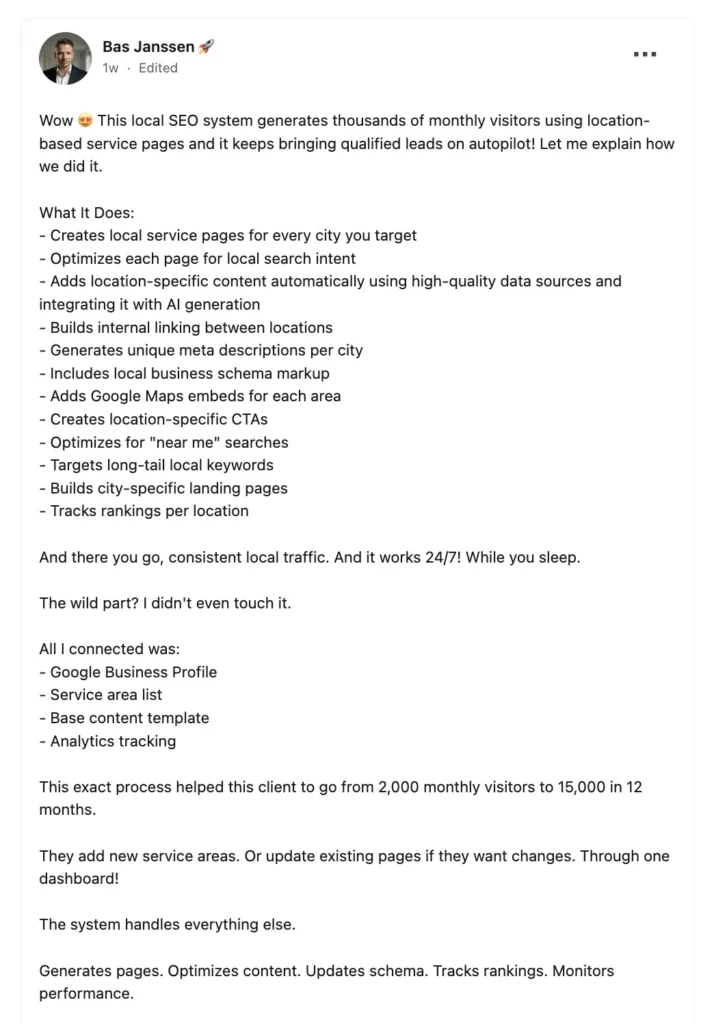
For example, this LinkedIn post talks about a fully automated SEO strategy for a local business. They used multiple AI agents that handle different SEO tasks to produce content that’s basically ready to publish.
Personally, I don’t think we’re fully there yet, but this is definitely an AI SEO trend we’ll see a lot more of in 2026 and beyond.
6. Traditional SEO KPIs are becoming obsolete
When I talk about “traditional SEO KPIs,” I mean keyword rankings, organic traffic, CTR, and similar metrics.
But these old metrics don’t really help us measure how well a brand performs in AI search results.
Even though most companies still focus on traditional KPIs, the shift toward new metrics has already started.
Kevin Indig, whom I met at the SEO conference in Toronto in October 2025, mentioned that old-school KPIs just don’t make sense anymore. Even the #1 organic result appears so far down the page now that many users never even scroll to it.
Instead, the KPIs of the future will likely include things like:
- brand recall and awareness surveys
- crawl data by user agent in log files
- LLM sentiment across topics and prompts
- number of citations and snippets
- impressions from the #1 position
- conversions coming from LLMs and Google
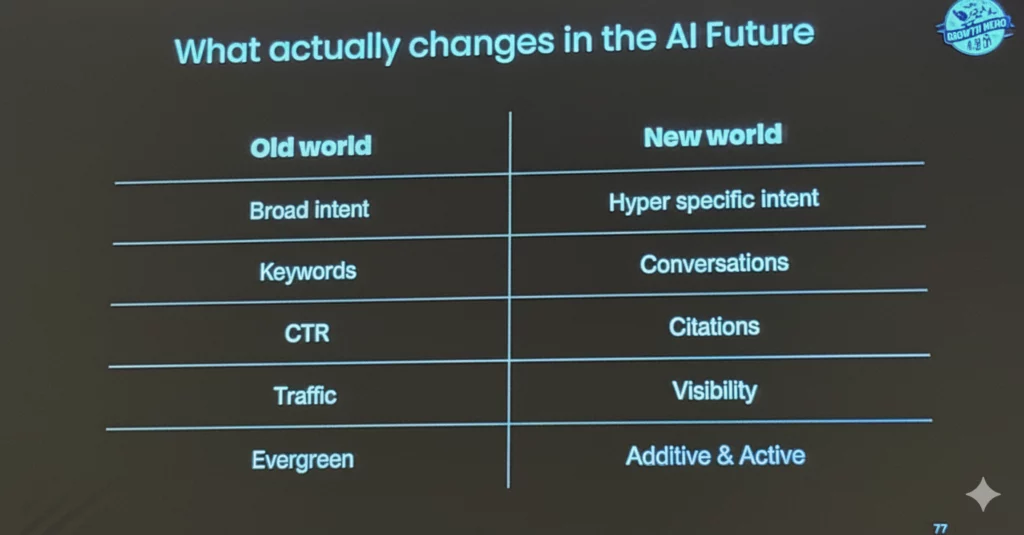
Kevin also showed us this slide breaking down the massive changes we SEOs are experiencing in the AI era — things we all need to keep in mind when planning SEO campaigns.
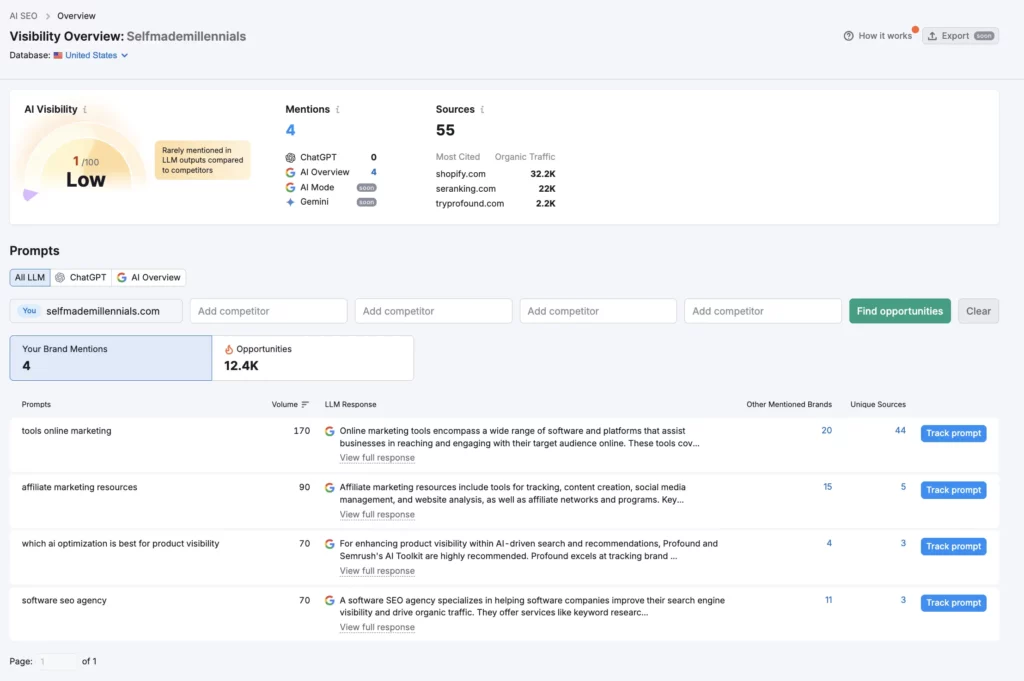
If you haven’t started tracking your brand in AI search yet, Semrush’s AI Visibility Toolkit is currently the most complete solution.
Here’s what it can help you do:
- See how often your brand appears in AI-powered search
- Track prompts and queries where your brand is mentioned
- Analyze your site’s AI crawlability
- Compare your AI visibility to competitors
- Understand how LLMs perceive your brand and content
To wrap up
These were some of my thoughts on AI and SEO trends for 2026.
AI is definitely changing the game, but that doesn’t mean you should give up on your SEO content strategy.
Keep going.
Just don’t rely on Google as your main traffic source forever.
Now more than ever, it’s important to diversify your traffic and show up on platforms beyond traditional search.
SEO is no longer only about rankings — it’s about showing up wherever your audience is and building real relationships with them.
As we move forward, the real key to success will be staying flexible, trying new things, and staying ahead of the curve.
Focus on creating meaningful content and connecting with your audience, and the traffic will follow.
You can also review my recommended SEO courses to further develop your skills.

Join the newsletter for actionable SEO tips, case studies, and a behind-the-scenes look at my affiliate marketing journey.
No spam. Unsubscribe anytime.
0 Responses
Thank you, you wrote a great article.