

I started doing SEO back in 2019, and one of the very first tasks I got was keyword research.
At that time, I had no idea what I was doing. I remember spending an entire day just staring at an Excel sheet, trying to figure out how to sort the keywords and which keyword metrics actually mattered for the business. It felt overwhelming because I knew if I picked the wrong keywords, it would be a huge waste of time with no results.
It took me years of trial and error to finally learn how to research keywords quickly, without checking every single idea one by one.
These days, I use the following strategies to research keywords depending on the need:
- If I already have a keyword idea, I check its ranking potential.
- If I have no clue where to start, I plug in one seed keyword and generate thousands of keyword ideas.
- I conduct a competitor analysis to steal their top traffic generation keywords aligned with my business needs.
I go deep into all of these methods in my SEO ebook (it’s 110 pages long because I literally break everything down step by step).
In this article, I’ve pulled out the most critical parts from the keyword research chapter and summarized them into clear steps you can follow.
What keywords should you focus on?
Choosing the right keywords is critical, especially if your website is still growing and lacks strong domain authority. In such cases, I recommend focusing on two main types of keywords:
- Informational long-tail & medium-tail keywords: These keywords reflect users who are looking for answers or detailed information. They often have lower competition and help you attract a targeted audience interested in learning more about your niche.
- Transactional and commercial medium-tail keywords: These keywords indicate an intent to buy or take action, making them valuable for driving conversions and sales.
These types of keywords show you exactly what people are searching for. And when you understand their intent, it’s much easier to create content that gives them the answers they’re looking for.
Additionally, these keywords usually come with less competition, so you have a better shot at ranking.
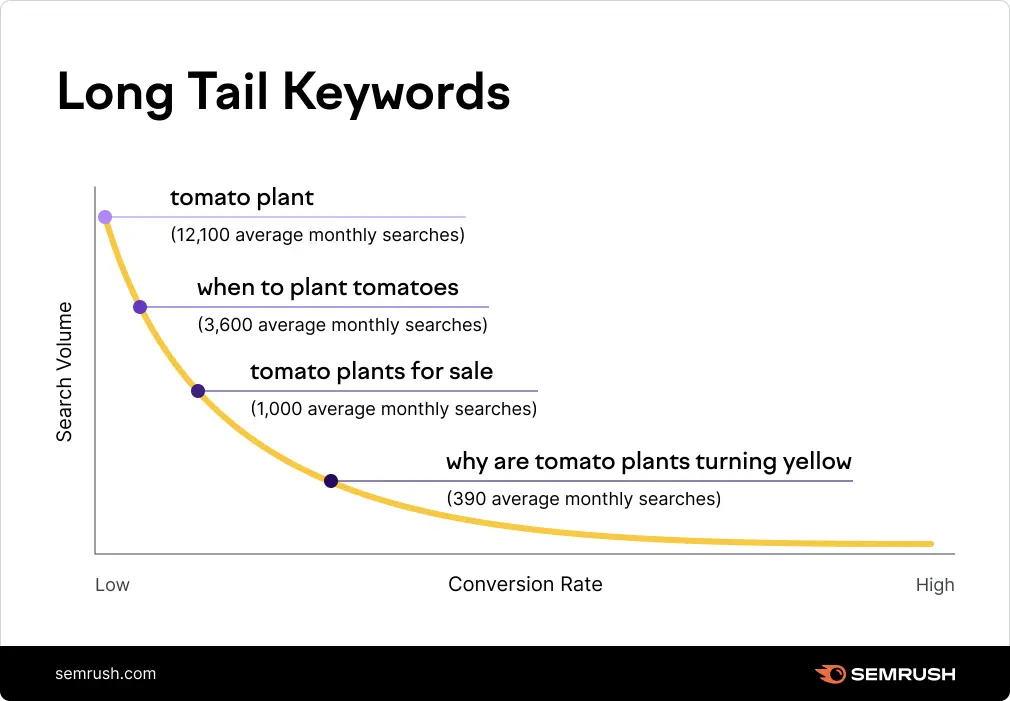
Take a look at the Semrush’s graph below. It breaks down how different keyword types perform.
For example, the keyword “tomato plant” gets a huge number of searches. But it’s way too broad. Do people want gardening advice? Maybe they’re looking to buy tomatoes? You can’t really tell, which makes it tricky to create the right content.
Now compare that to “when to plant tomatoes” or “why are tomato plants turning yellow.” These are super specific. You instantly know what users want, which makes it easy to write a helpful article and even recommend products or services naturally along the way.
Generally, long-tail keywords tend to have lower search volume but higher conversion potential because they match more specific search queries. Medium-tail keywords strike a balance between volume and specificity, while short-tail keywords often have very high search volume but are highly competitive.
How I do keyword research for SEO
To illustrate my keyword research process, I’ll use my own website as an example.
The first step is to identify the business goals you want to achieve. Keyword research and content creation should never be done just for the sake of it. Every piece of content should help your business achieve some objectives, such as generating more sign-ups, increasing product sales, or securing partnerships.
For my website, the goal is to generate more partnerships with brands. To achieve this, I need to understand what motivates my target audience, SEO teams, contractors, and small business owners, and what would encourage them to collaborate with me.
After talking to some of my partners, I realized that their primary motivation is to boost organic visibility for their products through my website. With this insight, I can focus on ranking for keywords that matter to my target audience and help them reach their goals.
Here’s a simplified table that outlines my decision-making process before selecting keywords.
This approach ensures that the keywords I target align with my business goals and my audience’s interests.
| 1. Business goal | 2. My audience | 3. Content Cluster | 4. Keyword ideas |
|---|---|---|---|
| Get more partnerships | SEO teams SEO contractors Small business owners | SEO tools | Semrush review AI SEO tools AI marketing tools Tool comparisons |
How to analyze keywords
After collecting some keyword ideas, the next step is to analyze them carefully.
When I analyze keywords, I aim to answer the following questions:
- Does my keyword have search volume?
- How competitive is my keyword?
- Can my website realistically rank for this keyword in the top positions?
To answer these questions, you’ll have to use SEO tools. I don’t have a detailed overview of the best keyword research tools for this task. This would have made the article very long. However, if you are looking for some tool recommendations, I have added a very brief paragraph in the FAQ section at the end of this post.
As I’ve been doing SEO since 2019, I’ve literally tried all kinds of tools for keyword research. My go-to tool nowadays is Semrush SEO Toolkit. I know it’s a bit pricy, but it offers tremendous value. Besides, they have a free plan that you can use daily for doing some quick SEO checks.
There’s one more reason I use Semrush — I trust their numbers. I agree that most of the SEO tools provide estimates, but Semrush’s numbers and keyword rank tracking work for me.
I suggest using Semrush’s Keyword Overview to estimate your keyword potential.
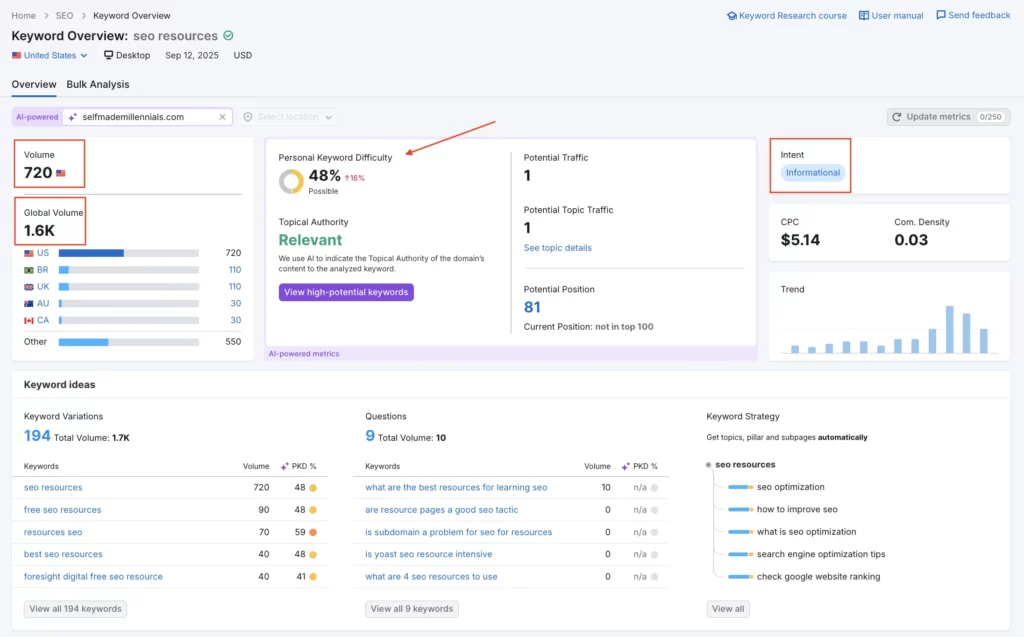
Below, you can see an example of the report for the “SEO resources” keyword generated with Semrush.
I suggest reviewing the following metrics to analyze the keyword potential:
- Global search volume: 1,600 users globally search for this keyword monthly
- Search volume in the USA: 720 users out of 1,600 are based in the USA and search for this keyword monthly
- Search intent: users mainly search for this keyword to learn something new, that’s why the intent is informational.
- Keyword difficulty: 48/100, which means the environment is competitive, but my website has potential
If you have a Semrush Pro subscription, I highly suggest benefiting from lots of AI-powered features. For example, you can assess the keyword difficulty specifically for your domain.
Semrush uses AI to assess how closely your website’s content aligns with the keyword and how competitive the field is, specifically for your domain. That’s a powerful feature!
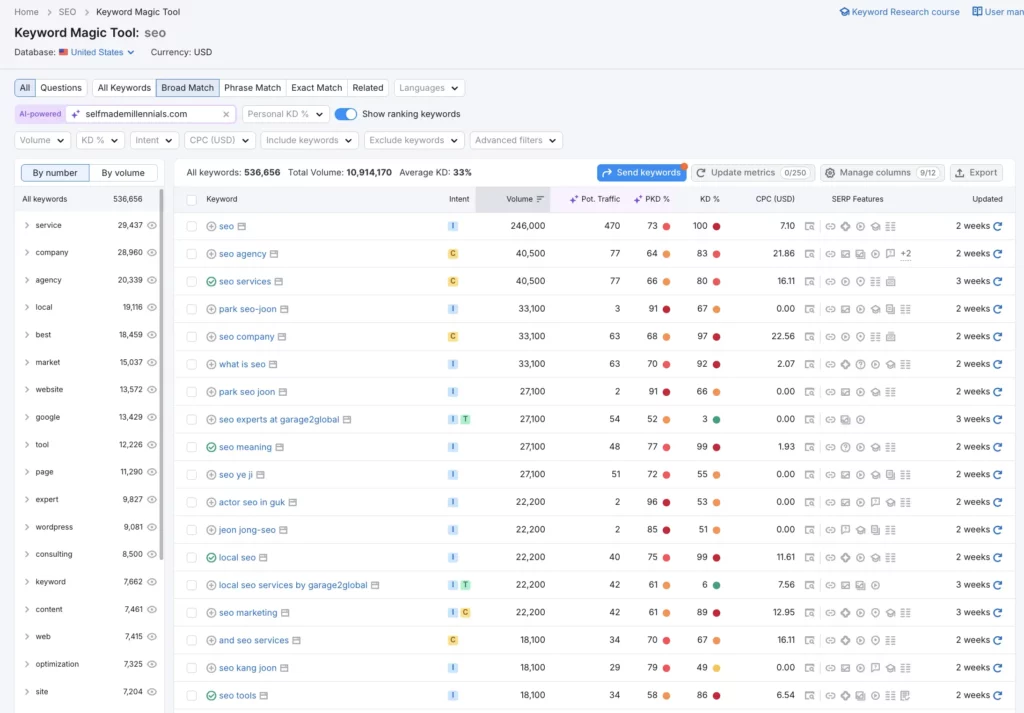
If you don’t know where to start when it comes to keyword research for SEO, I suggest using a Keyword Magic Tool to generate thousands of solid keywords from one topic idea (seed keyword).
I rely on this report most of the time since you can immediately spot lots of keywords without guessing if they have potential. Additionally, you can use filters to get a list of keywords based on your preferred search volumes and keyword difficulty.
If you know your keywords, you can also spy on their keywords and pick the ones that your website doesn’t rank for yet.
Semrush, just like many other tools, offers a Keyword Gap report for competitor keyword research.

How to research related keywords
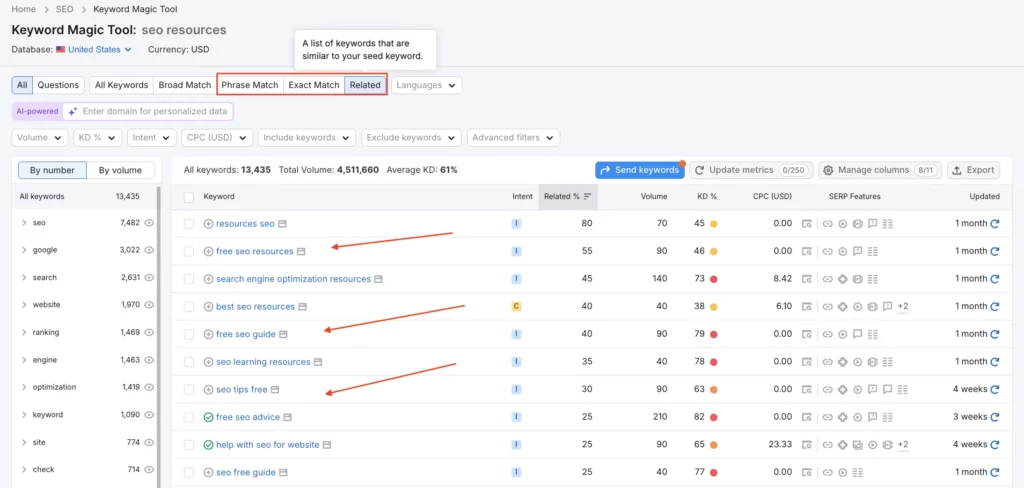
Related keywords are words or phrases that give extra context and make it easier for search engines to understand what your content is about.
One simple way to find related keywords is to check Semrush’s “Related,” “Phrase match,” “Broad match,” and “Questions” reports.
Of course, you can use other keyword tools too. The tool isn’t the most important part. What really matters is how you use it.
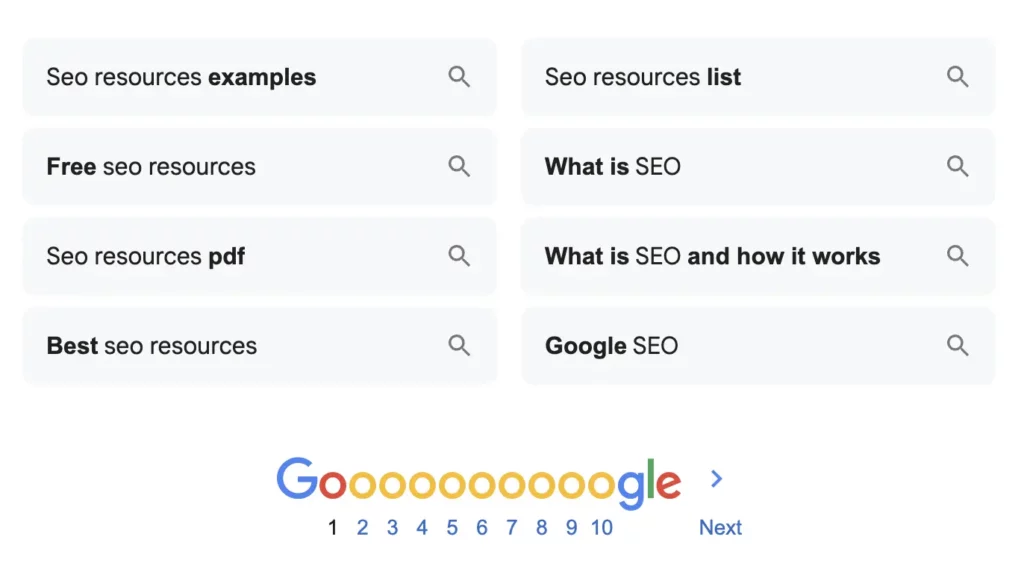
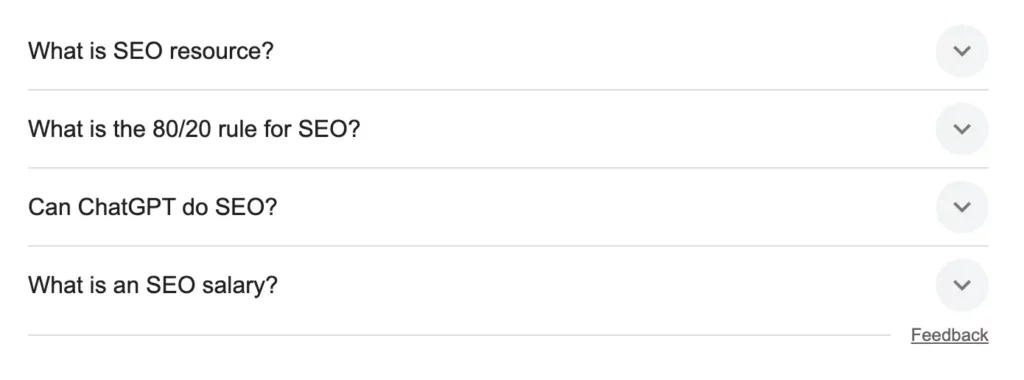
The Google search result page also shares many insights about users’ search intent. In particular, you can find secondary keywords in the “People also ask” and “Related searches” sections.
People also ask:
AI-powered SEO tools can help with keyword suggestions and optimizing content. Some popular choices include Semrush Content Toolkit (formerly Contentshake AI), Ahrefs’ AI Content Helper, Surfer, and Rankability, to name a few.
Personally, I use different tools depending on which ones are available to me at the moment. Most of the content SEO tools work similarly. Based on your main keyword, it generates a list of related terms that could improve your content. Although not all suggested keywords may feel relevant, the overall recommendations are usually valuable.
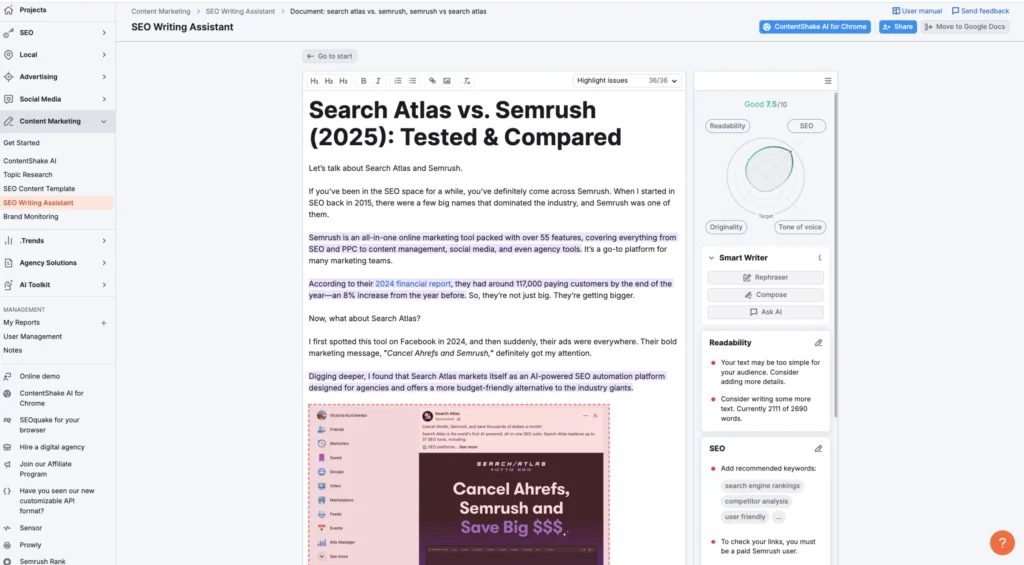
For example, Semrush’s SEO Writing Assistant is a handy tool for content optimization. It suggests secondary keywords and shows which ones you’ve already used in content. Plus, it highlights potential gaps, helping you spot opportunities to make your content even stronger.
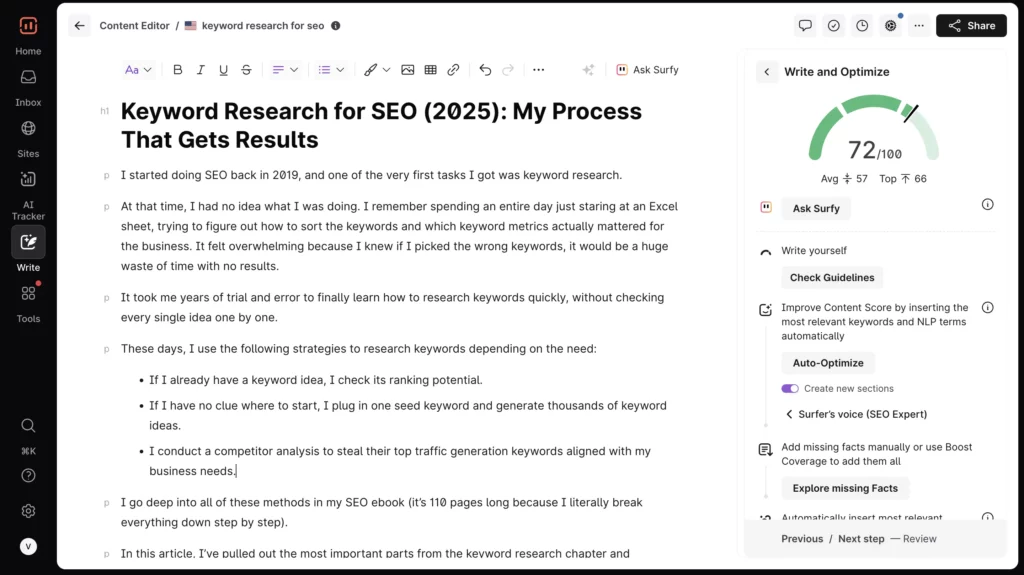
You can also use Surfer to check how well your content piece is optimized and add missing related keywords if there are any.
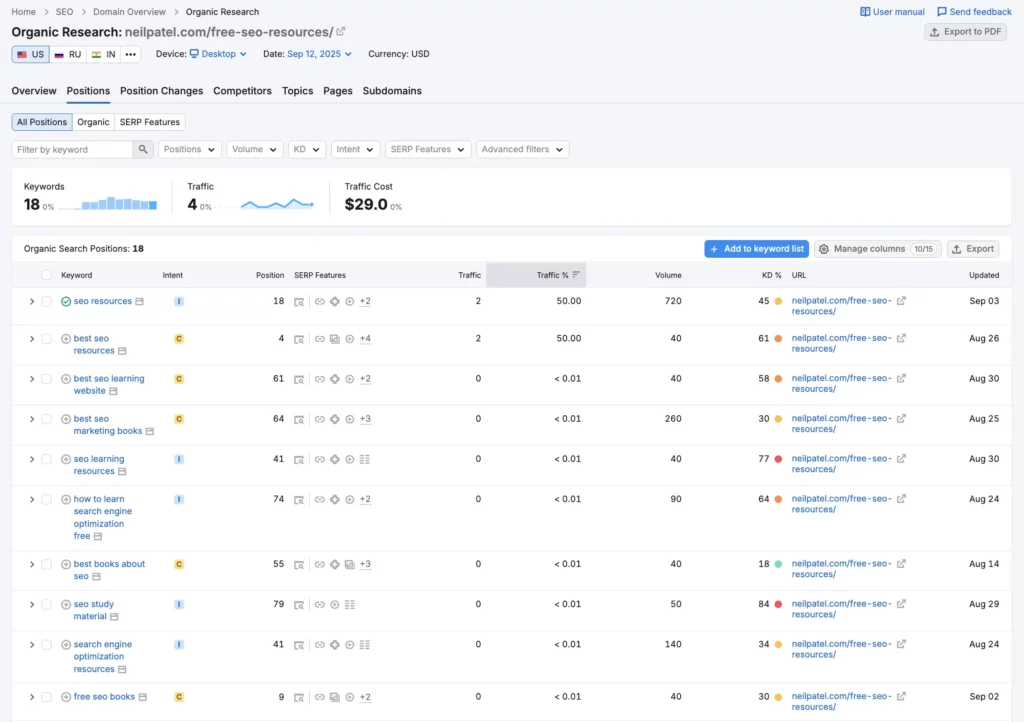
You can also check out your competitors’ URLs one by one to see which keywords they rank for. This can give you a good idea of the key terms you should include in your own content.
For instance, in Semrush, you can find this information in the Organic Research report.
When collecting secondary keywords during your seo keyword research, I suggest creating a table similar to the one below. It helps visualize the bigger picture and understand the keywords your article should cover.
Below is a list of semantically related keywords I collected for the term “SEO resources.”
These keywords provide insights into what users are looking for when searching for SEO resources.
You can adjust the list by adding or removing keywords as needed. The key is to ensure comprehensive coverage of your target topic.
| Target keyword: SEO resources |
|---|
| Related keywords |
| Free SEO resources |
| Best SEO resources |
| SEO learning resources |
| Best resources for content marketing SEO |
| SEO training resources |
At this point, I’d say the keyword research part is done.
However, it’s just one step in the content production process. The keyword list should help you create an outline that aligns with user search intent and holistically covers the entire topic. Once the content part is done, you also need to know how to optimize the content piece so it has a higher chance of ranking in search results and popping up in AI-generated search results.
I delve deeper into these topics in my comprehensive SEO ebook, which covers my entire SEO approach and content creation strategy in detail. If you want to master SEO keyword research and content optimization, I highly recommend checking it out. I’m also working on more guides about on-page SEO and SEO writing, so stay tuned for upcoming articles.
Let's recap
Before diving into keyword research for SEO, keep these essential points in mind:
Different types of keywords you’ll work with:
- By priority: Target keywords (primary focus) and related keywords (secondary).
- By search intent: Informational (seeking knowledge), transactional (ready to buy), commercial (considering purchase).
- By length: Short-tail (broad), medium-tail, and long-tail (specific) keywords.
The type and competitiveness of the keywords you choose will influence your ability to rank in organic search.
How to find the right keywords:
- Use Semrush’s Keyword Overview or similar tools to check keyword potential, including both the search volume and keyword difficulty.
- Generate keyword ideas with Semrush’s Keyword Magic Tool or equivalent keyword research tools.
- Spy on competitors’ keywords using Semrush’s Organic Research or Keyword Gap reports.
- Find related keyword ideas through keyword tools’ “Related,” “Phrase match,” “Broad match,” and “Questions” reports.
- Check “People also ask” and “Related searches” on Google for additional keyword suggestions.
SEO and keyword strategy for my website
I’ve been consistently working on my website for the past two years with two main goals: diversifying my income and testing different SEO strategies.
To me, a personal website that actually performs well is one of the strongest proofs of your SEO skills. My website generated over $40,000 in 2025, which tells me I’m on the right track with my business goals.
After running my website on my own for years, I’ve learned one big lesson: success comes down to picking the right keywords and focusing on what really matters for your business. Every keyword I target is chosen carefully. It has to support my business goals and help grow my site’s organic traffic.
Here’s how I approach it:
- I use Semrush for keyword research and steal keyword ideas from competitors.
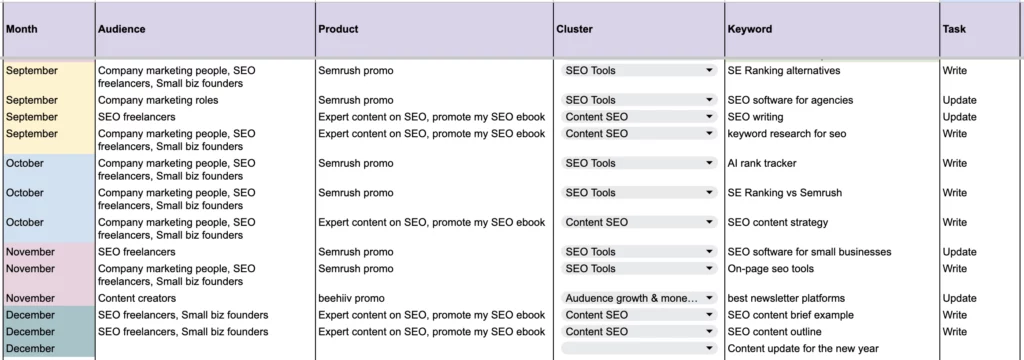
- Before each quarter starts, I review my website’s performance, figure out which pages are worth updating, go through the list of keyword ideas I’ve collected, and put together a fresh plan for the next three months.
My goal is simple: keep my top-performing posts ranking well while adding new, high-quality content.
You’ll find my SEO content plan for the rest of 2025 below. Nothing fancy, just consistent, optimized, and useful content that’s written for readers first.
I know that my audience is interested in reading in-depth and insightful posts that aren’t like anything else published on the web. They know they’ll be able to learn more about my hands-on experiences, which is becoming rare these days.
While others publish for search engines, I create content for people. This “back-to-basics” SEO strategy is exactly why my website continues to grow and even outperforms bigger players, despite Google’s algorithm updates.
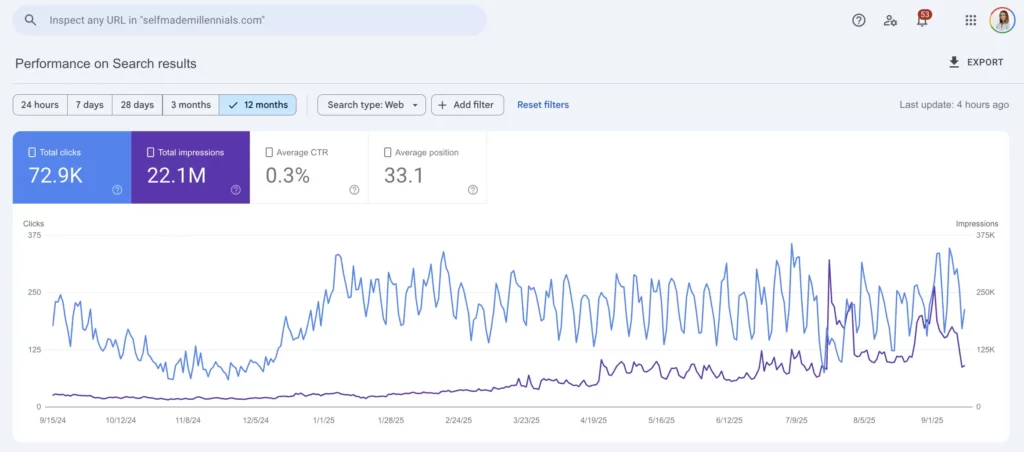
Looking at my Google Search Console, my website’s impressions have been steadily growing over the last 12 months. Clicks jumped up after the November 2024 core update.
During the August 2025 spam update, things look a bit uncertain, but I’m not worried. I don’t buy links, and I turn down almost every guest post request, so I’m confident my site is safe.
Some people ask why I don’t outsource keyword research and SEO content writing to scale faster.
I’ve tried it twice, and both times the content wasn’t up to my standards. I had to rewrite it myself. I’d much rather put my money into technical SEO improvements and a design revamp, both of which give me higher returns.
Creating and implementing all my content and design ideas takes a lot of time and effort. But the payoff has been worth it.
If you’d like a deeper look into how I handle keyword research, content outlines, and optimization, you can check out my SEO ebook.
FAQ
If you are looking for some general advice on keyword research and the best keyword research tools, I’ve shared brief responses below based on my experience.
What’s keyword research?
Keyword research is about finding the exact words and phrases people type into search bars.
It helps you ensure that there is a search demand for whatever you want to write about. If your page ranks high in Google for those specific words, you’ll get a steady flow of people who are already looking for what you’re offering, which is a big win!
Is keyword research important for SEO?
Yes, keyword research is essential for SEO because it can help you understand your audience’s search intent, keyword difficulty, and whether your keyword idea has a ranking potential.
What are the best keyword research tools?
If you’re wondering which keyword research tools are worth trying, I can share a few based on my own experience.
Semrush is my go-to tool for keyword research and analysis for my website. I also published a detailed Semrush review of it if you’d like to dig deeper.
I’ve also used Ahrefs for years, and it’s still a solid option. If you’re debating between Semrush and Ahrefs, I wrote a post on Semrush vs. Ahrefs comparison that breaks down their features and metrics side by side. It’s worth mentioning that I stopped using Ahrefs because their organic traffic numbers are way off.
Other tools I’d recommend checking out are SERanking and Search Atlas.
For local SEO keyword research, I’d suggest using Google Keyword Planner. Even though this tool is primarily used for paid search ads (Google Ads), it provides solid estimates for organic search as well.
What are the four types of keywords for SEO?
The four main types of keywords are:
- Informational keywords (seeking knowledge)
- Navigational keywords (looking for a specific website)
- Transactional keywords (ready to buy or take action)
- Commercial keywords (researching products or services before purchase)

Join the newsletter for actionable SEO tips, case studies, and a behind-the-scenes look at my affiliate marketing journey.
No spam. Unsubscribe anytime.