


As an SEO specialist and a content writer, I’ve spent the last few years helping SaaS startups, B2B companies, and even small local businesses create impactful SEO content strategies. But even though I’ve done this work countless times, I never shared my full process.
Here’s why: I couldn’t openly share client data. And because I’m a huge fan of the “show, don’t tell” approach, I kept pushing this article aside… until today.
So why am I finally writing it now?
Because in 2025, my own website brought in $40k in revenue from my SEO content strategy that I put together last December. If interested, I’ve shared all my journey, step by step, with all the details in my monthly recaps and affiliate reports.
$40k is a massive jump compared to 2024, when it only made a little over $10k. I followed the exact same steps I normally use for clients.
This means you finally get a real, behind-the-scenes look at how I create SEO content strategies that aren’t just “nice to have,” but actually tied to business goals and revenue.
As always, no fluff, no filler, just the essentials you need to build a strategy that works.
Let’s dive in.
What’s an SEO content strategy?
An SEO content strategy is your roadmap for what to write, why you’re writing it, and how that content will help you show up in search results and convert readers into customers.
You may think I added this section just for SEO purposes. Well… yes and no!
Indeed, including optimized FAQs can help boost search visibility. But the bigger reason is that my definition of an SEO content strategy might be a bit different from what you’ve seen before, so I want us to start from the same foundation.
And there’s another valid reason why I added this FAQ at the beginning of the post. This paragraph is intentionally structured in a way that LLMs can easily pull it out and surface it in AI search results. It’s a simple strategy I picked up from Semrush’s LLM optimization case study (more about it later in the post).
Even though this article isn’t about AI SEO or LLMs specifically, this part matters. AI search is already influencing how people discover content, so thinking about LLM-friendly structure should be part of your SEO content strategy moving forward.
My AI and SEO content strategy in 10 steps
This is the exact strategy I used to grow my website traffic by over 73% compared to 2024 and bring in around $40k in revenue from affiliate marketing and brand collaborations.
And even though I wrote this post at the end of November 2025 (with a few weeks still left in the year), the numbers are already stable enough to talk about. If anything, they might look even better by the end of the year.
Step 1: Set tangible goals
Before you create a single piece of content, you need to identify the business goals you want to achieve. That’s the heart of a real SEO content strategy.
Creating a strategy takes time, money, energy, and a lot of brainpower. So, doing it “just to do it” is the fastest way to burn out and see zero results.
And if your past strategies didn’t perform the way you hoped, there’s a good chance your goals weren’t well-defined in the first place. No shame, most businesses skip this step because it feels “too simple,” but this is exactly where the process should start.
Your SEO content strategy should directly support your business goals, such as:
- increasing sign-ups,
- boosting product sales,
- attracting more partnerships,
- improving brand visibility,
- growing your email list.
- etc.
Nothing vague. Instead, you should set specific and measurable business goals.
So, before you jump into keyword research or content planning, gather your team (if you don’t work solo) and try to answer the following questions:
Question 1: What is the ONE main goal I want my content to achieve this year?
Question 2: Who exactly is the audience I want to attract?
Question 3: What does this audience care about right now?
Question 4: What type of content actually influences their buying decisions?
Question 5: If my content works perfectly, what does “success” look like in numbers?
Let me walk you through how I approached this for my own website.
My primary goal in 2025 was simple: get more brand partnerships.
To do that, I needed to understand what motivates SEO teams, contractors, small business owners, and other companies that might want to collaborate with me. What do they look for? What results matter most to them?
After several conversations with my partners, the answer was surprisingly straightforward:
They want more organic visibility for their products, and they rely on my website to help them achieve it.
Once I understood that, everything else clicked into place.
My job wasn’t just to write “good” content. My job was to rank for the keywords my potential partners care about, so collaborating with me becomes a no-brainer for them.
Here’s a simplified version of my thought process. This method makes sure I don’t choose keywords randomly. Every topic aligns with my business goals and what my audience cares about, which is why the strategy worked so well.
| 1. Business goal | 2. My audience | 3. Content Cluster | 4. Keyword ideas |
|---|---|---|---|
| Get more partnerships | SEO teams SEO contractors Small business owners | SEO tools | Semrush review AI SEO tools AI marketing tools Tool comparisons |
Step 2: Understand who your target audience is
Your target audience is the group of people you want your content to speak to. These are the readers you want to attract, educate, and eventually convert. Ideally, your content should catch their attention right away and make them think, “Wow, this person gets me.”
But grabbing people’s attention today is harder than ever. We’re competing with endless content — blog posts, AI-generated summaries, videos, social updates, newsletters… all fighting for the same pair of eyes. And the competition isn’t slowing down.
That’s exactly why you need to know your audience inside out, including their struggles, goals, motivations, and the questions they keep Googling at 11 PM. When you understand what they actually care about, you can create content that speaks directly to them.
So, how do you do it?
There’s no single “right” way. It really depends on your resources and time.
At one of my previous workplaces, we ran user research interviews every quarter. We invited real customers, spent about an hour with them, and asked everything about their business, their goals, and their experience working with us. Those conversations were insights you’d never find by just browsing the web.
If your company uses a CRM like HubSpot, that’s another goldmine. CRMs can show you where your users came from, what pages they viewed, and how they interact with your website. That type of behavior data can tell you more about your audience than any SEO tool ever will.
Here’s an example from my own website: I can see every page a prospect visited before filling out my contact form, and that information alone says a lot about their intent and interest level.
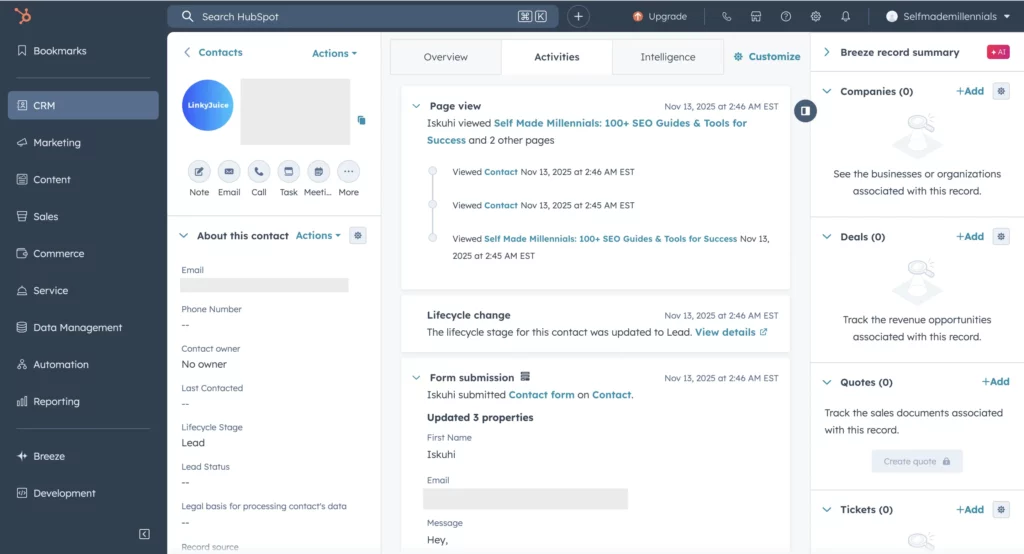
But since I run my own business now, I’ve adapted a different approach, and honestly, it works well for me.
As an affiliate partner of multiple reputable companies, I can track all leads from different pages of my website. And this is not just numbers: I see their name, their company name, and sometimes even their position. That’s more than enough to understand who is landing on my content and why.
For example, based on data from 164+ tracked leads, I know that people who land on my “AI SEO Tools” page from organic search results are typically:
- SEO contractors
- SEO leads
- Startup founders
- Local business owners
- In-house SEO specialists
- And similar roles
These people have different budgets, team sizes, and levels of SEO knowledge, but their main goal is the same: find the most suitable SEO tool they can trust to grow their business.
And that’s where my job comes in.
As a website owner and a content creator, my responsibility is to understand their intent, create content that matches that intent, keep them engaged, and ultimately convert that interest into revenue through affiliate links, partnerships, or future collaborations.
Once you know who your audience is and what they want, you’re finally ready to move on to the next step of building your SEO content strategy.
Step 3: Research keywords
Keyword research helps you identify the most relevant keywords based on your business goals that have search volume.
Whenever I analyze keywords, I try to answer three simple but essential questions:
- Does this keyword have monthly search volume?
- How competitive is it?
- Can my website realistically rank on the first page for it?
To answer these, you’ll need SEO tools. I’m not going into a full comparison of tools here (otherwise this article would turn into a 10,000-word guide), but if you want recommendations, I added a short list in the FAQ section at the end.
Since I started doing SEO back in 2019, I’ve tested pretty much everything: Ahrefs, Moz, Ubersuggest, Mangools, Google Keyword Planner, you name it. After all this trial and error, Semrush SEO Toolkit became my go-to SEO Tool. Yes, it’s on the pricier side, but the data quality is worth it, and their free plan still lets you do small daily checks.
Another reason I stick with Semrush is simple: I trust their numbers. Every SEO tool provides estimates (none of them are perfect), but Semrush’s keyword metrics and rank tracking have consistently matched my real-world results.
To evaluate keyword potential, I typically start with Semrush’s Keyword Overview report. It gives you a clean, snapshot-style look at whether a keyword is worth investing your time into.
Here’s an example using the keyword “SEO resources.” When analyzing a keyword, I recommend focusing on these metrics:
- Global search volume: Shows how many people search for the keyword worldwide (in this case: 1,600/month).
- Search volume in your key market: For me, the USA matters, and 720 monthly searches is a healthy number.
- Search intent: Semrush labels this keyword as informational, meaning users want to learn something, not necessarily buy something immediately.
- Keyword difficulty: KD of 48/100 tells me the competition exists, but my website has a real chance of ranking with strong content.
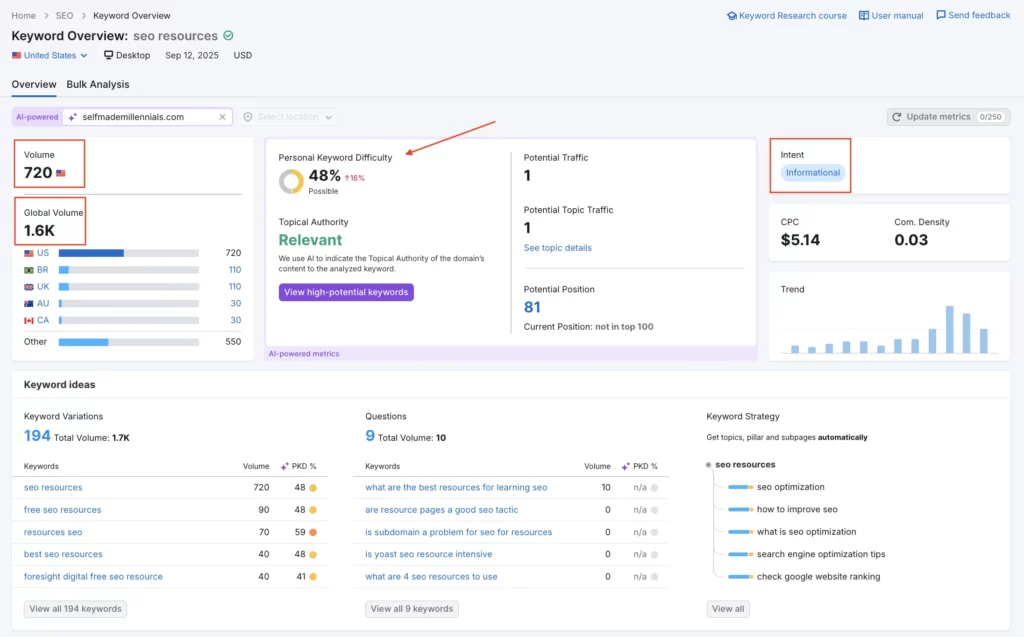
If you use Semrush SEO Toolkit or Semrush One (AI + SEO toolkits), you get an even more powerful feature: AI-powered keyword difficulty for your domain specifically. If you want to learn more about the tool, I’ve published an in-depth Semrush review with my insights from using the tool.
This means Semrush analyzes:
- how well your existing content aligns with the keyword,
- how authoritative your domain is compared to others,
- how competitive the ranking landscape is for your website, not in general.
It’s basically a personalized forecast of your ranking potential, and honestly, it saves a ton of time and second-guessing.
In short, keyword research isn’t just about picking “popular words.” It’s about choosing the right battles, the ones you can realistically win, and the ones that move your business closer to its goals.
Step 4: Create content clusters
Clusters help to structure content on your website. They help people (and search engines) better understand what your website’s topical authority is based on what you write about most often.
Topical authority matters more than ever. Search engines like Google are slowly moving toward recommending content from brands and creators who are known in their niche.
We’ve all seen big players like HubSpot try to rank for tons of unrelated topics just because they had strong domain authority.
The search results used to be dominated by giants with high domain authority (a metric that can be manipulated). It used to work, but those days are gone.
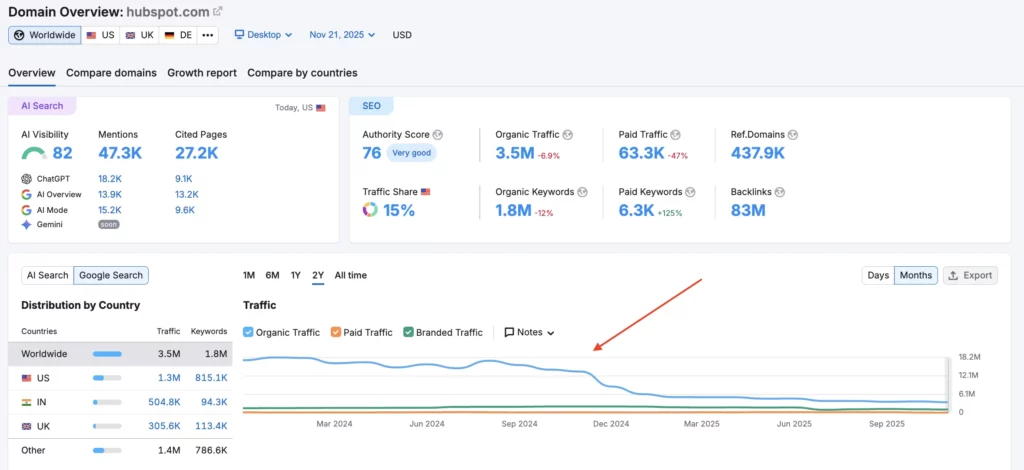
There are many ways to group keywords into clusters. But if you’re working with a huge list, like thousands of keywords, you can’t (and shouldn’t) do this manually. You need a reliable tool to handle that workload.
I’ve tested and reviewed some keyword clustering tools in marketing to help you quickly pick the most suitable solution for your needs.
Personally, I use a top-down approach. Instead of forcing random keywords into groups, I start with a topic idea, usually something that fits a website category, and then build clusters around it with Semrush’s Keyword Strategy Builder.
It works differently from many other tools on the market. It generates content clusters from your recommended topic and suggests pillar and subpages for the clusters, of course, with all the keyword data you need to make a data-driven decision.
Using Semrush, I was able to quickly create multiple content clusters for my website just from one seed keyword, “SEO Tools.”
You can review my example below or try to create a content cluster for your website with Semrush on your own during a 14-day free trial of Semrush SEO Toolkit.
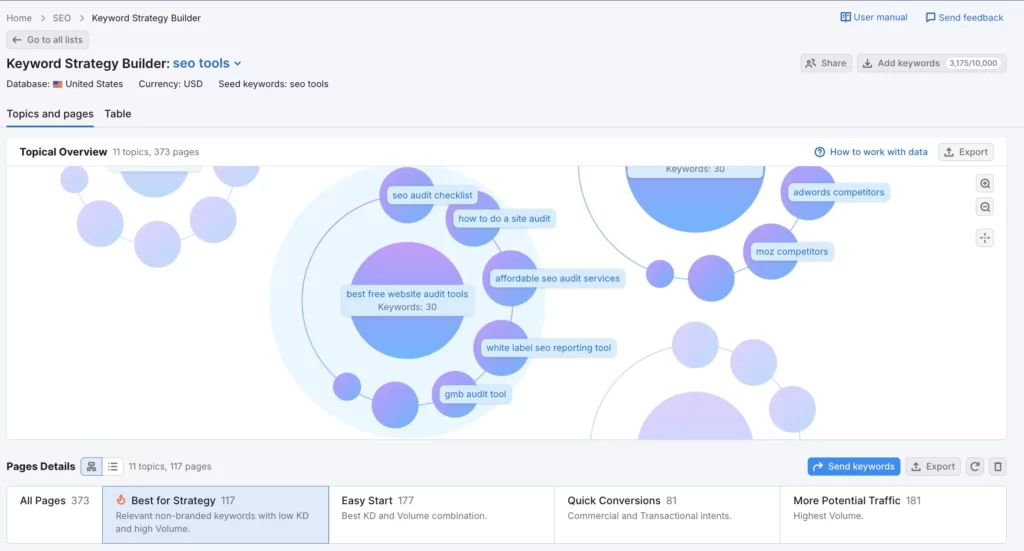
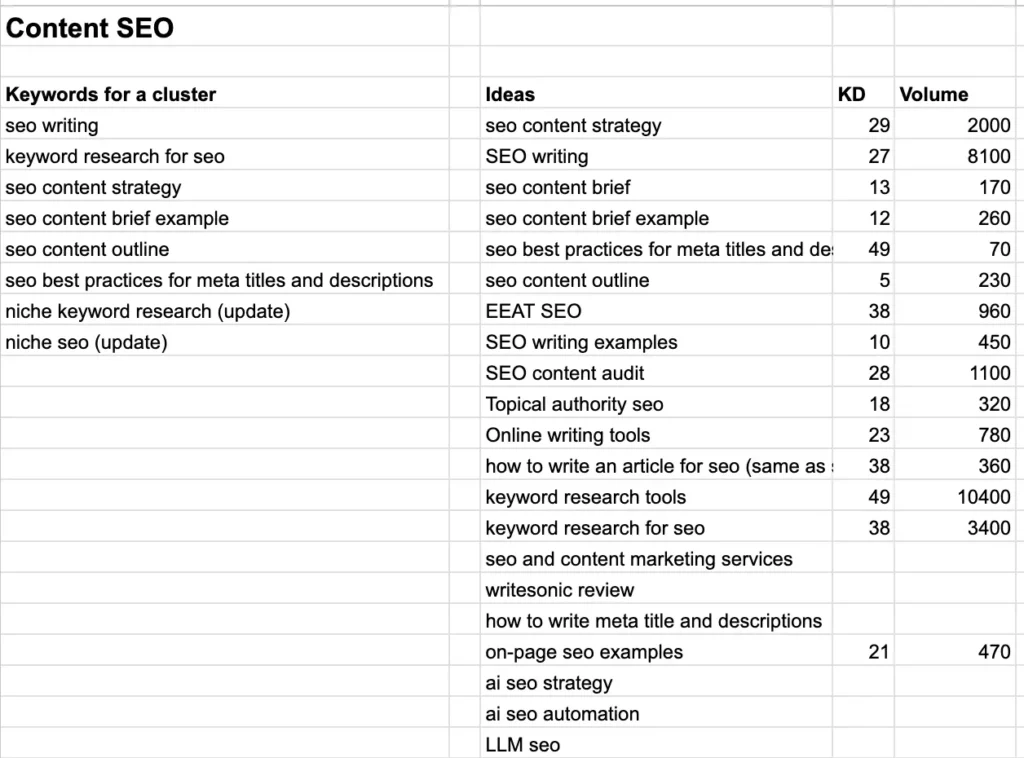
Once the clustering is done, my goal is simple: understand which content clusters and pillar pages I should build next.
Below, you’ll see my finalized “Content SEO” cluster and the keywords I found with Semrush that are ready to be added.
In the next step, I’ll show you how I use all this keyword data to create a content plan.
Step 5: Put together a content plan
When you are done with keyword research, you have many topics to write about.
What should you start with?
Picking the keywords with the highest search volume isn’t always the best strategy. Your ultimate goal is to attract potential customers, not random traffic.
As Tim Soulo, Ahrefs CMO, once said:
How do you prioritize keywords to get the highest output from your content?
Focus on keywords with business potential.
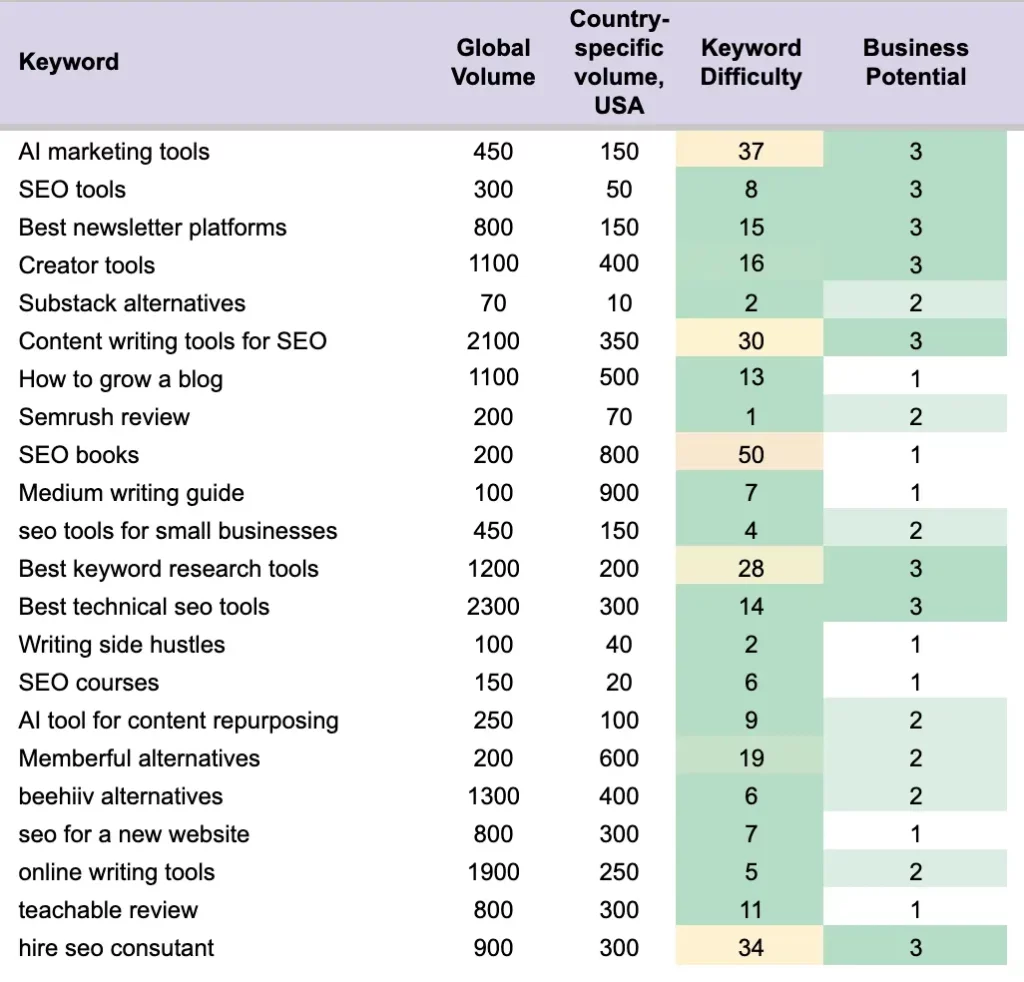
Assign 3 points if you answer “yes” to all the questions below when analyzing your keywords. If a keyword isn’t as important, it’ll score 2 or even just 1 point. Simple as that.
- Can this keyword bring me potential customers?
- Do I have products and services I can offer users who will visit my website through this keyword?
- Can my products solve the needs of people visiting my website through this keyword?
Use these questions to critically assess your keywords and prioritize the ones that will help you make money from your website as soon as possible.
You can set keyword priorities right in your Excel sheet.
The screenshot below shows how I did it for my website. I researched many SEO-related keywords, but prioritizing them helped me pick the best ones—those with traffic potential and a chance to earn affiliate commissions.
Keywords with 3 or 2 points are the top choices for content.
Now, is the time to put your keywords together into a content plan.
A content plan is your roadmap for what you’ll publish on your website and when.
As an SEO writer and a website owner, I always map out my content at least 3–6 months ahead, ideally, a full year.
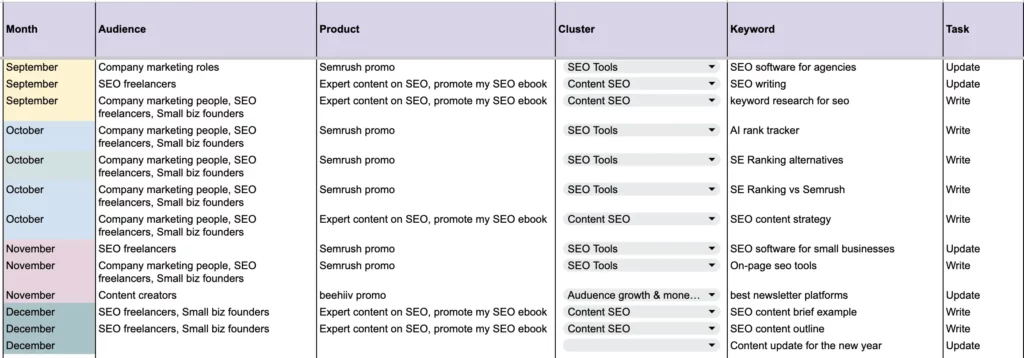
Below, you can see an example of the content plan I use for my website, which is built around these key goals:
- Helping me build my personal brand as an SEO expert and a content writer
- Increase the number of brand collaborations
- Boost affiliate income
To reach these goals, each keyword in my plan should support at least one of them, preferably all of them!
Below is my content plan for 2025. Keywords highlighted in green mean I’ve already written new content or updated an existing page. I stick to 4-5 pieces per month. That’s because I manage most of the tasks myself, so I don’t have time for more. Plus, publishing more content doesn’t automatically lead to faster organic growth.
Even though I often miss deadlines, my website has exceeded my expectations and generated over $40,000 in 2025 alone.
If interested, join my newsletter, where I share all my website-related progress, including a website earnings 2025 summary coming at the end of December.
Step 6: Ensure your website is ready for content plan implementation
Technically speaking, a full site audit isn’t usually part of creating an SEO content plan. Content strategy and technical SEO are two completely different skill sets, and honestly, two different jobs.
But even the best content strategy will fall flat if your website has critical technical issues.
I learned this the hard way.
At one of my previous workplaces, I managed multiple business accounts and watched incredible content fail simply because the websites had critical technical problems. It didn’t matter how strong the keyword targeting was or how well the articles were written — the results never came.
I’m not saying you or your SEO content strategist need to perform a full, hours-long technical audit. That’s usually outside the scope of content strategy.
But you do need to make sure the most essential technical elements are in place before you start implementing your content plan.
Here are the key things you should double-check:
- Google Search Console + Google Analytics are set up properly. If these are missing, you can’t track performance.
- Your important pages (such as, service pages, product pages, money pages) are actually indexed. If web crawlers can’t find them, users won’t find them in organic search either.
- Your site has a clean sitemap. This helps crawlers understand your site’s structure and find new content faster.
- Meta titles and descriptions are in place. These heavily influence your click-through rate and appear in search results.)
- Your robots.txt file exists and hides sections that shouldn’t be indexed
(admin pages, staging environments, user dashboards, etc.) - You use H1, H2, H3, H4 headings correctly. They help both users and crawlers understand what your page is about.
- Your site loads reasonably fast. Slow websites lose rankings and readers — Core Web Vitals matter.
- Your pages are mobile-friendly. Over half of all traffic comes from mobile; Google also prioritizes mobile-first indexing.
- Your internal links help web crawlers navigate. No orphan pages, clear linking between important sections.
If you want to go deeper, I published a separate post on “How Much Time Is Required to Get a Page Ranking”, where I break down what helps content get indexed faster and how to check if Google is actually picking up your pages.
Once you’ve confirmed that your website can appear and rank in search results properly, you’re finally ready to move on to the next step of your content strategy.
Step 7: Turn your findings into an AI SEO content strategy
AI SEO content strategy means optimizing your websites to appear in LLMs like ChatGPT, Gemini, Claude, AI Overviews, and AI Mode, as well as in traditional search results.
This is still a very new field. Even the most experienced SEOs don’t have a “perfect formula” yet. No one can guarantee that your brand will be cited by AI Mode or appear inside AI Overviews.
However, now we have many more studies on AI citations and mentions, and we know what can most likely help your business get there.
Let me walk you through my approach, heavily inspired by Semrush’s findings.
Here’s how I built an AI-SEO content strategy:
1. Track bottom-funnel prompts
Instead of broad queries like “AI SEO”, you want to understand and target more specific prompts where people are closer to making decisions.
Examples:
- “Best AI SEO tools for small businesses”
- “Semrush vs Ahrefs for keyword research”
- “Affordable AI tools for content writers”
LLMs tend to surface highly specific, intent-driven content. So, that’s where you want to show up.
2. Add natural product or service mentions
I suggest mentioning tools, services, or brands naturally in the content you already have. This is something Semrush found extremely effective in improving AI visibility.
3. Mirror your H1 in the first sentence
LLMs love clarity.
Example:
Heading: “What Is AI Visibility?”
First sentence: “AI visibility is your brand’s presence across AI-powered search and LLM platforms.”
It sounds almost too simple, but it works.
4. Be specific and give real numbers
Avoid vague statements like “traffic increased significantly.” Instead, use real data like “My traffic grew by 73% year over year.” LLMs prefer concrete facts they can cite.
5. Avoid metaphors and unclear language
LLMs struggle with figurative and indirect language. The clearer your writing, the better your chances of being included in AI answers.
6. Establish your expertise
Introduce yourself and explain why readers should trust you. LLMs factor in author credibility when deciding what information to surface. As I always say, aligning your website’s optimization strategy with Google’s EEAT can help you improve organic performance and AI visibility.
Why this matters
Semrush’s team implemented these AI-SEO tactics, and within just one month, they tripled their AI share of voice.
I spent a weekend reading their case study, and honestly… I was impressed by how transparent they were. They shared every tactic they used to increase AI visibility, and many of those learning shaped the exact strategy you’re reading right now.

If you haven’t started tracking your brand’s AI presence yet, Semrush’s AI Visibility Toolkit is currently the most complete option.
Here’s what it can do:
- Measure how often your brand appears in AI-powered search
- Track prompts and queries where your brand is mentioned
- Audit your site for AI crawlability
- Compare your AI visibility to competitors
- Understand how LLMs perceive your brand and content
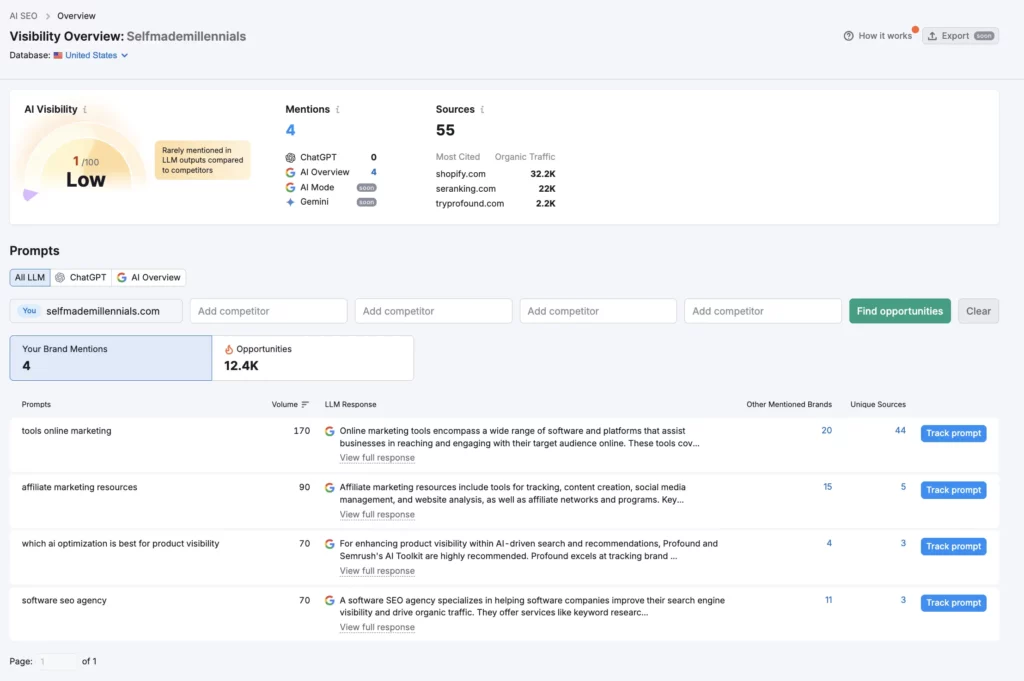
If you’re using the regular Semrush SEO Toolkit, you’ll still get a snapshot of your AI performance, not as deep, but still extremely useful for daily monitoring.
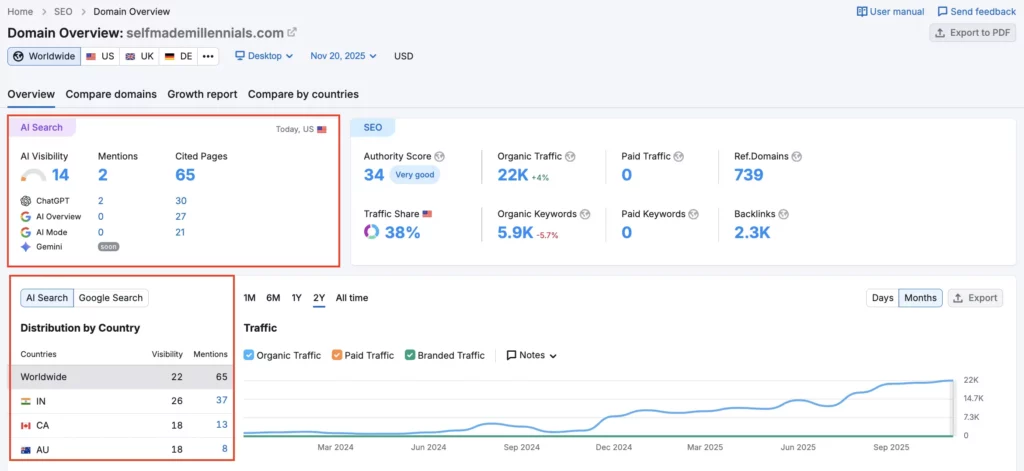
Semrush recently launched Semrush One, combining the SEO Toolkit + AI Visibility Toolkit. From what I’ve seen, it’s the most complete toolkit on the market for AI-SEO tasks. And the best part? You can try it free for 14 days.
One thing I strongly believe: Doing SEO for your domain alone isn’t enough anymore.
The days of depending solely on backlinks and keyword optimization are over.
LLMs pull information from everywhere — not just your website.
So if you want AI visibility, you need to show up in all the places LLMs learn from.
For me, that includes Medium, Reddit, and LinkedIn.
These platforms send strong signals that help LLMs understand who you are, what you do, and why you matter.
Step 8: Build a publishing workflow that works for you
This step is about setting up a workflow that helps you stay consistent without burning out.
Even the best SEO content strategy won’t help if your drafts sit untouched for weeks.
So, here’s what I recommend doing:
- Your content production cadence (e.g., 1–2 posts/week)
I aim to put together at least one high-quality post weekly. If you want to learn how I create quality content that ranks, take a look at my SEO writing guide.
And finally, choose the tools that speed things up for you. Grammarly, Notion, Surfer, Google Docs… use whatever removes friction.
This step builds the foundation that keeps your content machine running smoothly month after month.
Step 9: Promote your content
Once your content goes live, don’t let it collect dust. Promotion helps your pages get indexed faster, brings in early traffic, and can even attract natural backlinks. I keep my process simple and repeatable.
Here’s what I do:
- Share on LinkedIn. This is where I’m slowly building my personal brand by sharing my thoughts, new content, and behind-the-scenes updates.
- Repurpose for Reddit. Reddit posts can get hundreds of views in minutes. In my experience, it’s one of the best places right now to get quick visibility.
- Send a weekly newsletter. It’s a great way to connect with my audience and drive consistent traffic back to my site.
- Republish on Medium. Medium isn’t as strong as before, but with 21,000 followers, it still gives me a nice boost in visibility.
And don’t forget one of the most underrated tactics: internal linking. Linking from your existing content helps Google find and index your new pages much faster.
And one more thing ….
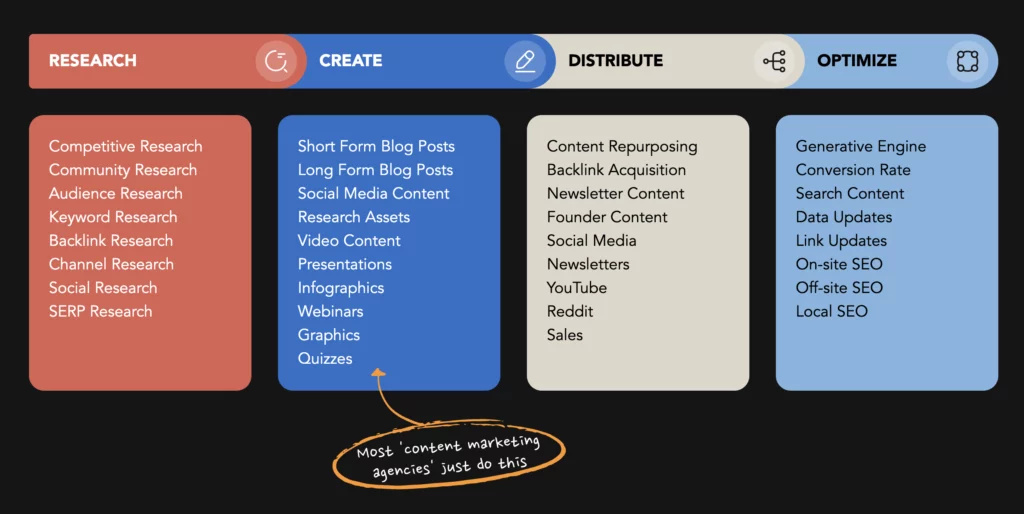
Ross Simmonds, the Founder and CEO of Foundation Marketing, shared his Content Growth Framework during the SEO IRL conference in Toronto. I had a chance to meet him there, and I think his framework is worth passing along—you might get a few fresh ideas for your own business.
Step 10: Measure your content performance
Even the best strategy needs ongoing tweaks, because SEO is never “set it and forget it.” It’s all about learning, adjusting, and improving.
Here’s what I recommend keeping an eye on:
- Your keyword rankings
- Organic traffic growth for each page
- Pages that get impressions but no clicks
- Pages stuck at positions 11–20 (these are usually easy wins!)
- Content clusters that might need extra supporting articles
- New queries your audience is using that weren’t part of your original plan
- Pages that start losing traffic or rankings
- AI visibility in LLMs
It also helps to stick to a simple schedule:
- Weekly: check Google Search Console for indexing and impressions
- Monthly: track your ranking shifts
- Quarterly: update your content plan and refresh any posts that need love
This is how you turn your content plan into a living system that grows with your website, instead of a static document that becomes outdated in a few months.
How do you like this post? Have you learned anything new? Let me know in the comments.

Join the newsletter for actionable SEO tips, case studies, and a behind-the-scenes look at my affiliate marketing journey.
No spam. Unsubscribe anytime.


0 Responses
Great read. Such valuable insights. I also appreciate the effort it took to compile this information. Many thanks.
Such a helpful guide, Victoria! Just shared it with my team 🙂 Have a great Christmas, and hopefully I’ll see you back on Medium. (I took a break this year but may jump back on in 2026!)
Thank you, Scott! 🙂