If you want to get better at SEO, you’re in the right place! 

Over the past years, I’ve tested countless books, courses, tools, and expert tips, keeping only the ones that worked for me and helped me grow. 

On this page, I’ve pulled together my go-to free and paid SEO resources for 2025. You’ll find books worth reading, courses worth paying for, and tools worth keeping in your daily workflow.

My go-to resources to become an SEO Pro

If you’re not sure where to start with learning SEO, I recommend diving into both courses and books at the same time.

Courses usually get straight to the point and go deeper into the details, while books often share more stories, which can be fun, but sometimes make it harder to pull out the practical tips. Still, using both together is a solid way to build your skills.

Below, I’ve put together my favorite books and courses to help you get started.

My own list of SEO books actually worth reading.

Most SEO trainings just talk about stuff. These aren’t. 

More free and paid SEO resources to learn from:

AI for SEO: My tips and strategies

If you’re curious about what’s going on in the world of AI and SEO, I’ve rounded up the latest trends and added my take on how to adapt. And if you’re a content writer, you’ll want to check out my tips on making AI content sound more human and ChatGPT for SEO.

Studies and expert opinions on AI and SEO.

Humanizing means aligning your content with Google’s E-E-A-T.

SEO tools to use

I’ve tried many different SEO tools while working on my own site and client projects. These are the ones I keep coming back to and happily recommend.

 Insights from an SEO expert, website owner, & content writer.

My experience with different AI-powered SEO tools.

FAQ

Everyone’s experience with SEO is different. Your starting point, skills, and goals will impact your learning path. Therefore, my journey will never look exactly like yours. I had to figure out a lot through trial and error, testing things on my own website, and learning from other top SEO experts.

If you’re just starting out, you’ll likely get the most value from free resources. A few great ones are Google’s SEO Starter Guide, the Semrush Learning Academy, and Aleyda Solis’ LearningSEO.io Roadmap. These will help you understand the basics without spending a dime.

But if you already know the fundamentals and want to level up, I’d recommend investing in advanced (often paid) resources. They’ll save you time, give you proven strategies, and help you skip the basic tutorials. 

Personally, I tried to find free but advanced SEO resources… and honestly, I couldn’t find anything that delivered real depth. That’s why I turned to paid courses from industry professionals, like Tech SEO Pro by Kristina Azarenko.

In short, I recommend starting with the free stuff to build your foundation, then consider paid training when you’re ready to take SEO seriously and move faster.


If you want to improve your SEO content marketing, I suggest learning from people who’ve already done it successfully. There’s a lot of noise online, so I prefer sticking to proven resources.

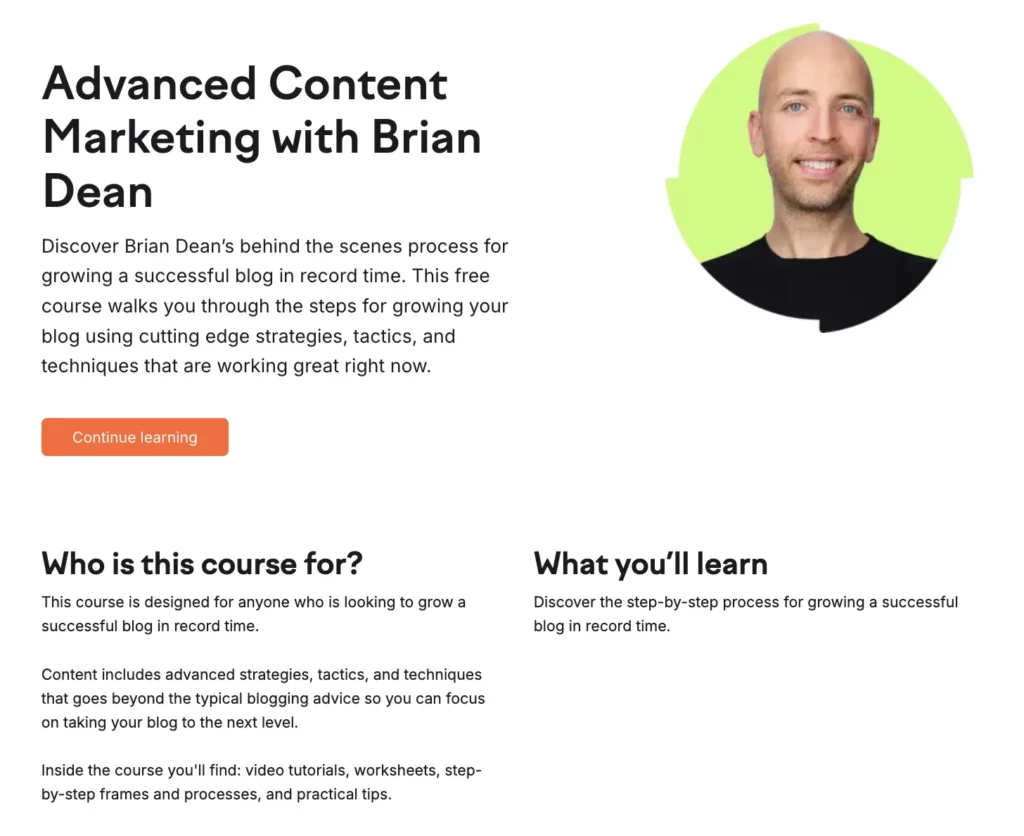
If you’re just starting, free courses are a great way to get your feet wet without spending a cent. One I recommend is the Advanced Content Marketing course from Brian Dean, the founder of Backlinko. It’s beginner-friendly but still full of strategies you can use.

SEO Resources free

From there, books can help you go deeper. I’ve put together a curated list of the best content marketing books—the ones that aren’t just theory, but give you actionable tips and real examples. These are perfect if you want to level up your skills over time.

And of course, don’t forget to follow top SEO blogs like Ahrefs and Semrush. They regularly share case studies and step-by-step guides.

No, SEO doesn’t require you to know how to code, at least not in the sense of sitting down and writing HTML, CSS, or JavaScript from scratch. 

Most employers won’t expect you to manually change code. However, it really helps to understand how a web page is structured. For example, you should know what header and body tags are, what meta tags like “noindex” or “nofollow” mean, and where to find them on a page.

It’s also helpful to know the basics of how JavaScript affects SEO, and how to spot issues with website crawling and indexability. These things fall under technical SEO. Even if you never plan to offer technical SEO services, learning the fundamentals is worth it. Because a lot of what makes a website rank well comes down to how easily search engines (and now AI models) can discover, read, and understand your content. 

If you understand the technical side, even just at a basic level,  you can identify problems early, work better with developers, and make smarter SEO decisions.

The 80/20 rule in SEO comes from the Pareto principle, which says that 20% of your efforts often bring 80% of your results

In simple terms, not everything you could do for SEO is worth doing. You don’t have to fix every tiny technical issue on your site, target every keyword, or publish endlessly blog posts just for the sake of traffic.

Instead, the real win is figuring out which few actions can help you achieve your business goals. That “20%” will look different for everyone. For some, it might be building high-quality backlinks. For others, it’s improving site speed.

Personally, my 20% is creating content that directly supports my business goals—articles that attract the right audience, answer their questions, and naturally guide them toward my services or products. That’s where I see the biggest return on my time and energy.

Yes, you can absolutely learn SEO by yourself, at least the basics.

Things like how websites get indexed, on-page SEO techniques, why link building matters, and what happens when Google rolls out updates are all skills you can pick up through self-study. There are tons of free and paid SEO resources (I’ve listed many on this page) that can help you get there.

But there’s a limit to how far you can go alone. 

At some point, you’ll need more advanced SEO skills that you can only really master by working alongside other experts. That’s why I don’t recommend spending more than a year learning all alone. You’ll grow much faster when you’re part of a team, asking questions, and seeing how professionals approach challenges.

Another great way to learn is to start your own website. That’s exactly how I learned a lot about SEO and content writing.

From My Desk to Your Inbox

Join the newsletter for actionable SEO tips, case studies, and a behind-the-scenes look at my affiliate marketing journey.

No spam. Unsubscribe anytime.