

If you are looking for a decent SE Ranking alternative, you are in the right place.
I’m an SEO specialist and a content writer who’ve been in the industry since 2019. Over the years, I’ve tried countless SEO tools to grow my website and help my clients.
In my experience, the market consistently pushes new tools to attract users. However, most of these tools flop because they don’t understand what we, SEOs, actually pay attention to — data accuracy.
If the data isn’t reliable, it doesn’t matter how pretty the interface looks or how many features a tool has. You just can’t make SEO decisions based on the wrong data.
Currently, I still have an active SE Ranking subscription (until January 2026) and have been using it for a few months.
Overall, I actually trust SE Ranking’s data more than Ahrefs these days. But a few things pushed me to explore other options:
- User interface: SE Ranking’s dashboard feels a bit cluttered because you have links all over the place, in the top menu and sidebar.
- Data visualization: It’s not as clean or easy to interpret as I’d like.
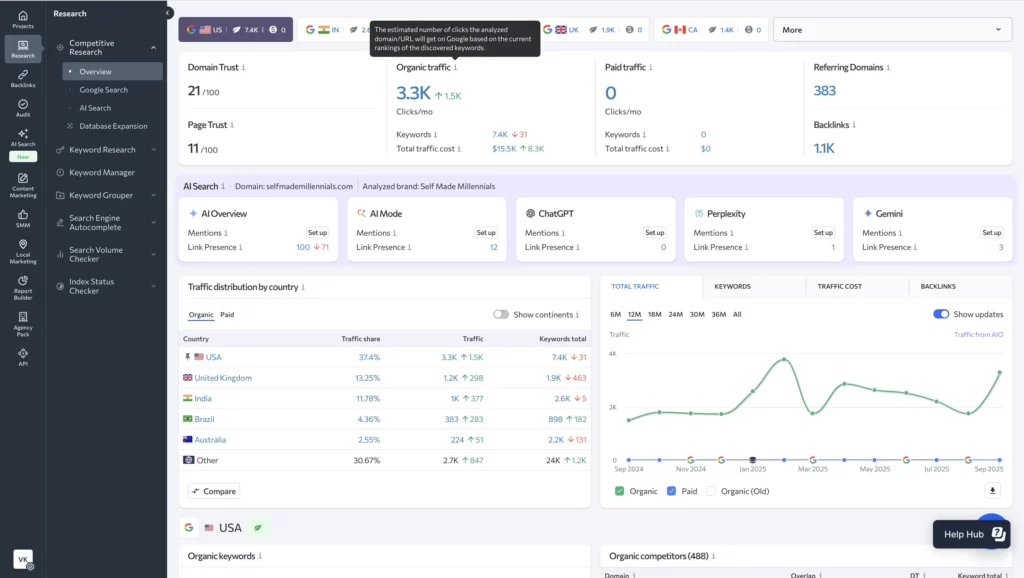
- Data accuracy: SE Ranking shows my website’s monthly organic traffic as just 3.3k, while my Google Analytics reports over 15,000 visits from different marketing channels. That’s a huge difference, which makes competitor analysis almost impossible to trust.
If you check the top suggested alternatives, you’ll see people mentioning Raven Tools, Mangools, Moz — all these tools are in no way decent alternatives.
Raven Tools, as a company, has been permanently closed, and the service is no longer updated or supported. Nevertheless, people continue to write about this tool on the web. That’s because they don’t even dare to check it.
Moz has got pretty bad user reviews on Reddit and other review platforms. I stopped using and recommending this tool, even though it used to be a go-to solution for SEO experts.
So, if you are currently looking for an alternative to SE Ranking or any other SEO tool, I can suggest just a few tools worth trying.
Here’s a quick overview for your convenience:
Let’s review every tool in detail.
P.S. This post includes a few affiliate links. If you decide to try any of these tools, I might earn a small commission at no extra cost to you. Just being upfront about it! I’m only recommending tools I’ve used myself and truly believe in.
1. Semrush
- Best for: SEO teams, SEO agencies, freelancers, and site owners.
- Best features: AI Assistant and its customized recommendations to your website, Keyword Magic Tool, On-Page SEO Checker, SEO Audit, Keyword Strategy Builder, AI SEO Toolkit, and more.
- Pricing: Starts at $139.95 per month. 14-day free trial for Semrush’s SEO Toolkit.
- Semrush One combines an SEO + AI Visibility toolkit to help you grow your website’s performance in organic search, LLM, and AI Mode. $199/month, 14-day free trial.
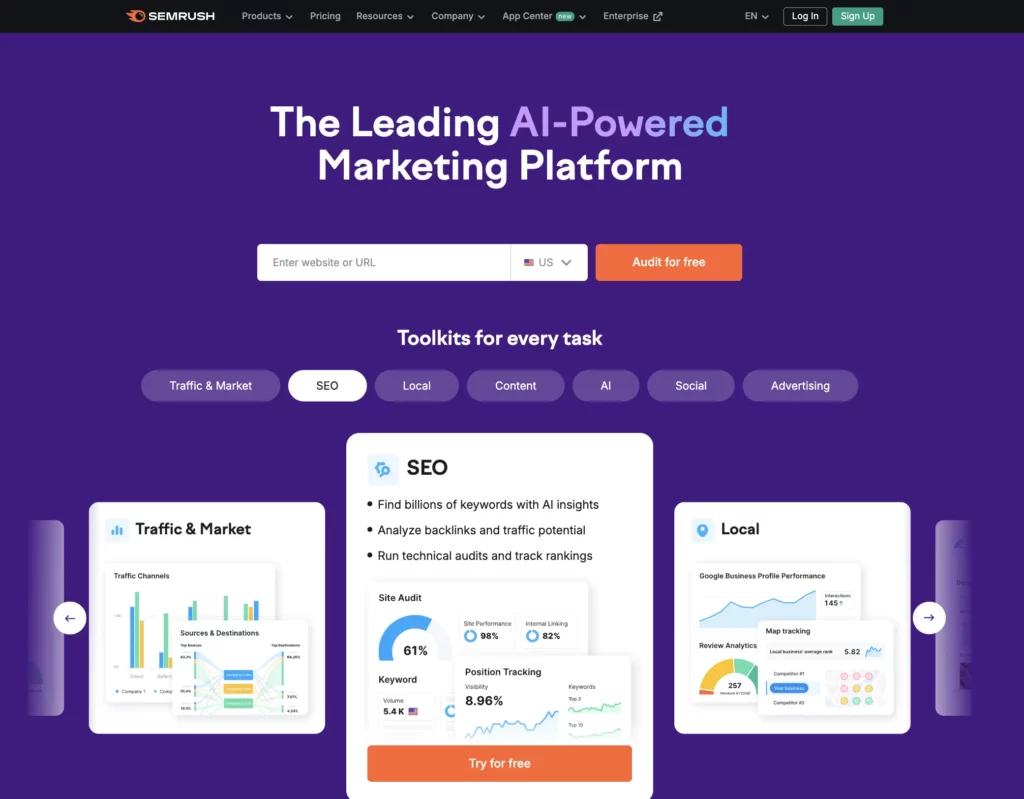
Semrush was the second SEO tool I tried (right after Ahrefs) when I started my career as an SEO specialist. Since then, it’s been one of my go-to tools for managing my own website and for client projects.
Over the years, Semrush has changed a lot. It’s definitely not the same tool it once was.
Today, it has over 55 features for all kinds of marketing tasks, grouped into seven toolkits so you can quickly find what you need for your project.
Here’s a quick breakdown of what each toolkit does:
- SEO Toolkit: Covers everything from keyword research and site audits to link building and domain analysis, basically, all you need to plan and improve your SEO strategy.
- Content Toolkit (former ContentShake AI): This toolkit can help you optimize your content production flow, from content brief generation to content creation and optimization.
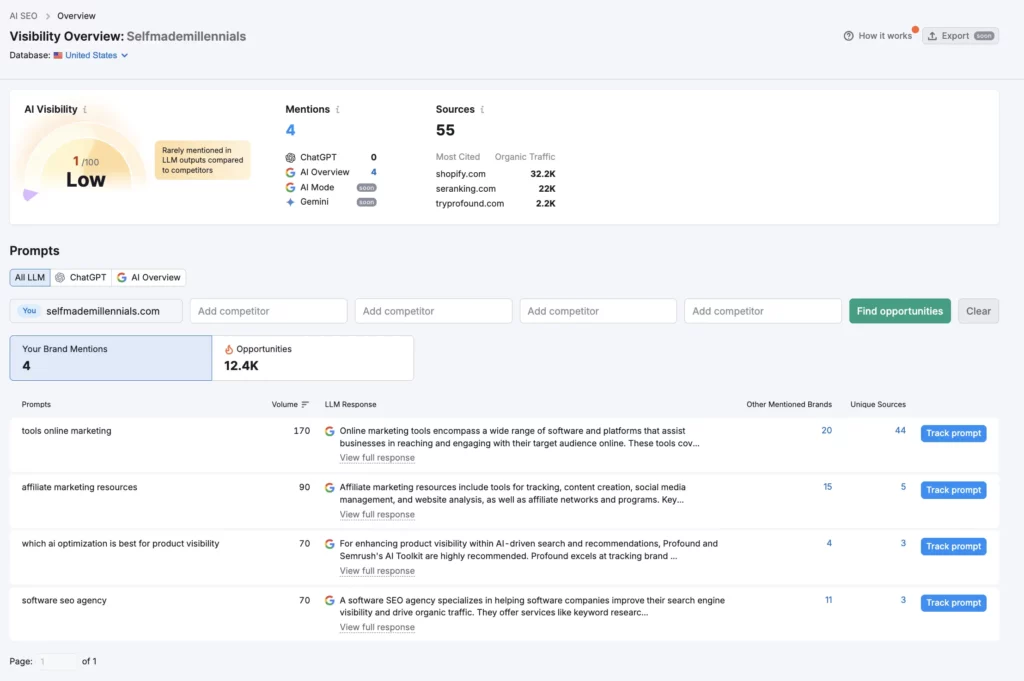
- AI Visibility Toolkit: It’s a new toolkit that lets you track how your brand appears in AI Overviews and LLMs like ChatGPT and Perplexity.
- Social Media Kit: It lets you manage all your social media accounts in one place.
- Advertising Toolkit: You can research, plan, launch, and optimize your online ad campaigns.
- Local Business Kit: It can help you manage your local business presence, including Google Business Profile and online reviews.
- Traffic and Market: This one can help you spy on your competitors (in a friendly way) to see what works for them and how they grow.
- Semrush One offers two SEO + AI Visibility Toolkits in one plan, giving you all the insights and tools you need to succeed in search engines and AI chat platforms.
If you want to learn more about Semrush’s features, I published a detailed Semrush review.

Semrush’s old pricing plans, Pro and Guru, now only cover the SEO Toolkit. If you want to use it, you’ll need to be on at least the Pro plan, which costs $139.95/month. It’s not cheap, but it’s less than what I used to pay for Ahrefs ($199/month).
Before you commit to anything, I’d recommend trying the free trial first. You’ll get a feel for the tool and see if it’s actually worth the price.
On a side note, my partner’s links give you a 14-day free trial for Semrush SEO Toolkit and a 14-day free trial for Semrush One instead of the usual 7 days.
So, you get a full two weeks to explore it and decide if it fits your needs.
If you’re curious about AI-focused SEO, Semrush now has a dedicated AI SEO Toolkit for $99/month.
This toolkit automatically checks how your brand appears across AI search engines like ChatGPT, SearchGPT, Gemini, and Perplexity.
In simple terms, it helps you see how AI platforms perceive your brand compared to your competitors and offers practical tips to improve your content, products, and marketing. That way, you can show up more often in AI-powered search results.
If you’re a content creator or website owner, this is one of those must-have AI SEO tools to add to your stack.
How is Semrush compared to SE Ranking?
Both Semrush and SE Ranking are all-in-one SEO tools with multiple features to help you manage different aspects of your website growth, including SEO, content marketing, appearance in AI-generated search results, and more.
Below, you can see my brief comparison of these tools based on the key metrics as of October 2025:
Keyword database:
- SE Ranking: 5.4 billion keywords
- Semrush: 27.3 billion keywords
Backlink database:
- SE Ranking: 2.9 trillion links across 188 countries
- Semrush: 43 trillion links across 142 countries
Domain analytics
- SE Ranking: 357 domains indexed
- Semrush: 808 domains indexed
What this information means for you is that Semrush’s databases are much bigger. So, it can find more backlinks, track more domains, and help you dig into way more keywords compared to SE Ranking. Because of that, I also find Semrush’s metrics a bit more reliable.
I’ve done a quick check and compared Semrush and SE Ranking data to the numbers from my Google Search Console account. I believe this is the best way to assess whether you can rely on any tool for your SEO campaigns.
Here’s a quick overview of my website performance from September 2025:
| Category | Semrush | SE Ranking | Google Search Console |
|---|---|---|---|
| Organic traffic | 15.1k | 3.3k | 8.45k |
| Top 3 pages based on organic traffic | AI SEO tools Ahrefs alternatives AI marketing tools | AI SEO tools Ahrefs alternatives AI marketing tools | AI SEO tools AI marketing tools Ahrefs alternatives |
| Organic traffic estimate for the top-ranking page | 6.2k | 1.15k | 3.73k |
| Number of keywords | 3.7k | 7.4k | |
| Referring domains | 383 | 612 | |
| Number of backlinks | 1.1k | 2k |
2. Search Atlas
- Best for: SEO professionals, In-house SEO teams, SEO agencies, and individual site owners.
- Best features: OTTO SEO, an automated SEO AI assistant, AI Content Writer, Site Auditor
- Pricing: Starts at $99/month for the Starter plan with 2 user seats and 5 site projects. 7-day free trial. Credit card required.
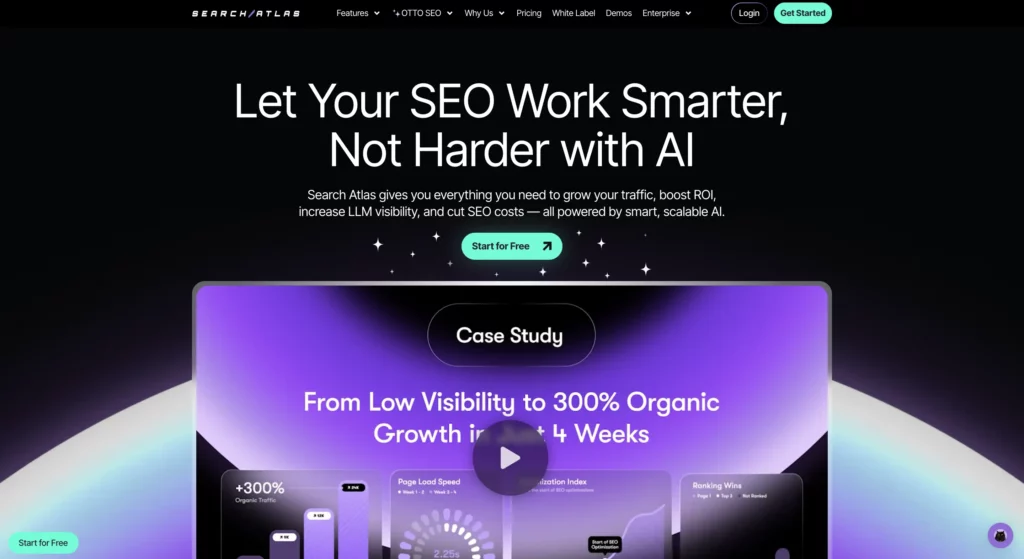
Search Atlas is a relatively new all-in-one SEO software for agencies powered by AI that launched in 2024. In my perception, they are getting attention very quickly by presenting their solution at various SEO events to catch people’s attention.
Search Atlas positions itself as a robust AI SEO tool and a fresh alternative to SE Ranking, Semrush, and Ahrefs.
I’ve used Search Atlas temporarily to better understand its features and what you can do with it. Here’s my quick recap:
- Analyze any website’s traffic, keywords, and backlinks
- See which pages and keywords bring the most traffic to your competitors
- Explore their backlink profiles
- Conduct keyword research for SEO
- Optimize your content and track its rankings
- Run technical SEO audits
- Spot link-building opportunities and even automate outreach
- Save time with their WordPress plugin and SEO OTTO automation tool
- Speed up content creation with their SEO Content Assistant
Pretty solid list, right?
What I like most is that you don’t have to use multiple tools for different SEO tasks since everything you need is right here in one place.
One more thing that I’ve noticed is its visual similarity to Ahrefs. If you’ve used Ahrefs before, the interface might look familiar. It also has features similar to Semrush, so it’s super easy to navigate. By the way, if you wonder how these tools compare, I’ve done a side-by-side comparison of Semrush vs Search Atlas.
If you want to learn more about the tool, I published a comprehensive Search Atlas review.
Now, let me show you what their Site Explorer report looks like, which I believe got inspiration from Ahrefs:
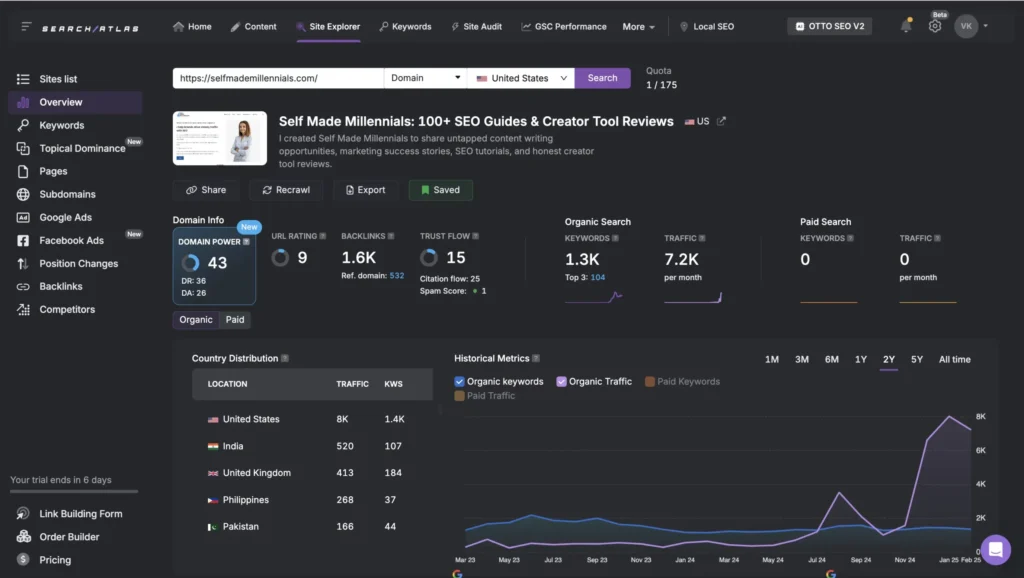
The table below shows how SE Ranking and Search Atlas compare in terms of data accuracy. It’s seriously my favorite thing to do – testing and comparing tools’ data accuracy.
Here’s the data comparison for my website from September 2025:
| Category | Search Atlas | SE Ranking | Google Search Console |
|---|---|---|---|
| Organic traffic | 10k | 3.3k | 8.45k |
| Top 3 pages based on organic traffic | AI SEO tools AI marketing tools Ahrefs alternatives | AI SEO tools Ahrefs alternatives AI marketing tools | AI SEO tools AI marketing tools Ahrefs alternatives |
| Organic traffic estimate for the top-ranking page | 2.75k | 1.15k | 3.73k |
| Number of keywords | 3.6k | 7.4k | |
| Referring domains | 568 | 612 | |
| Number of backlinks | 1.8k | 2k |
None of the tool’s data is perfect, as you can see. However, it seems to me that Search Atlas provides more accurate performance metrics for my website. Therefore, I can assume it does the same for other sites.
You might want to use their 7-day free trial to test the tool first before committing. This is a much better way to understand whether Search Atlas suits your business needs.
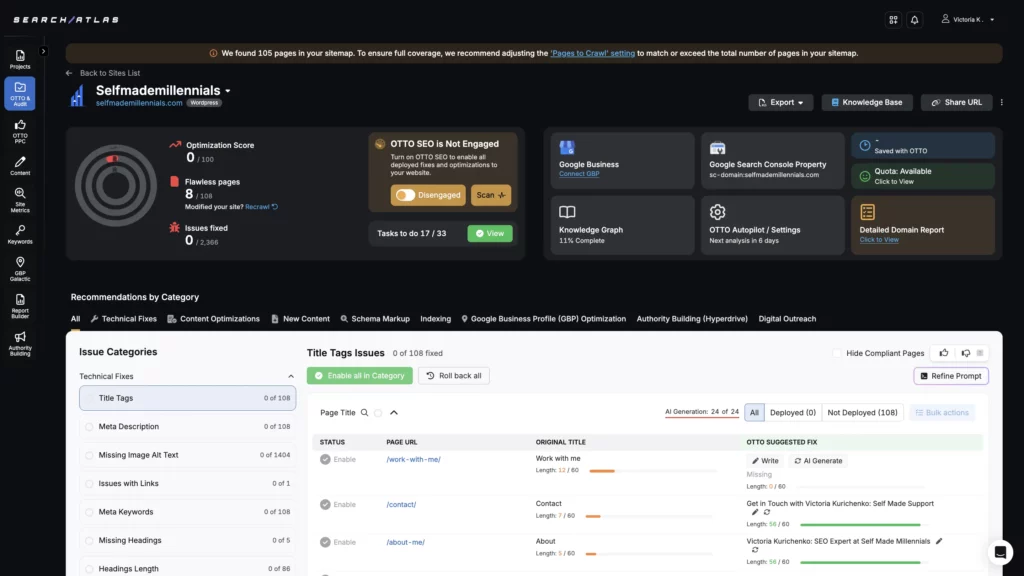
Let’s also talk about one of Search Atlas’ coolest features — OTTO SEO.
OTTO works like your personal AI assistant for your website. Once you add a small pixel to your site, it starts spotting technical issues, reviewing your content, and giving you improvement suggestions.
I don’t recommend relying on AI to implement the recommendations. Remember that this is just the tool, while you’ll be the one dealing with the issue if anything breaks on your website. Instead, I suggest using OTTO as an audit tool. This way, you can review and prioritize the recommendations and focus on the ones with the bigger impact.
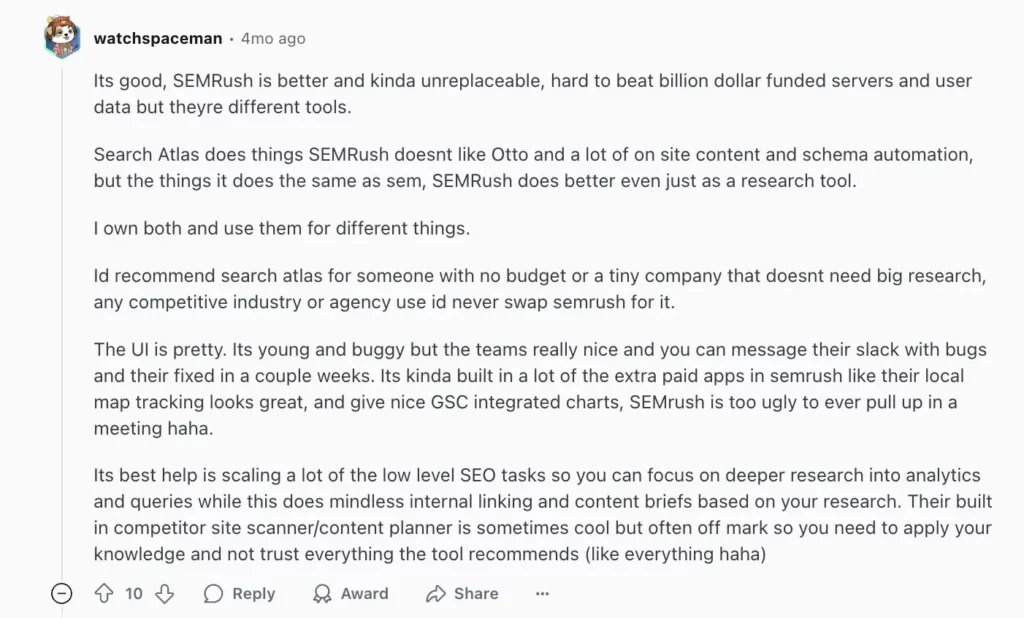
I’ve also checked what people share about Search Atlas on Reddit. Here’s one user testimonial that I personally relate to.
I also agree that it’s difficult to outperform Semrush with its giant database that they’ve been polishing since 2008, when they launched. However, it’s becoming more expensive and complex. Actually, you might have noticed that Semrush has switched to a new business model where you have to pay for every toolkit that you use, which were part of Semrush’s Pro and Guru plans in the past.
That’s when Search Atlas can be helpful, and I agree that it can be handy for small businesses and contractors.
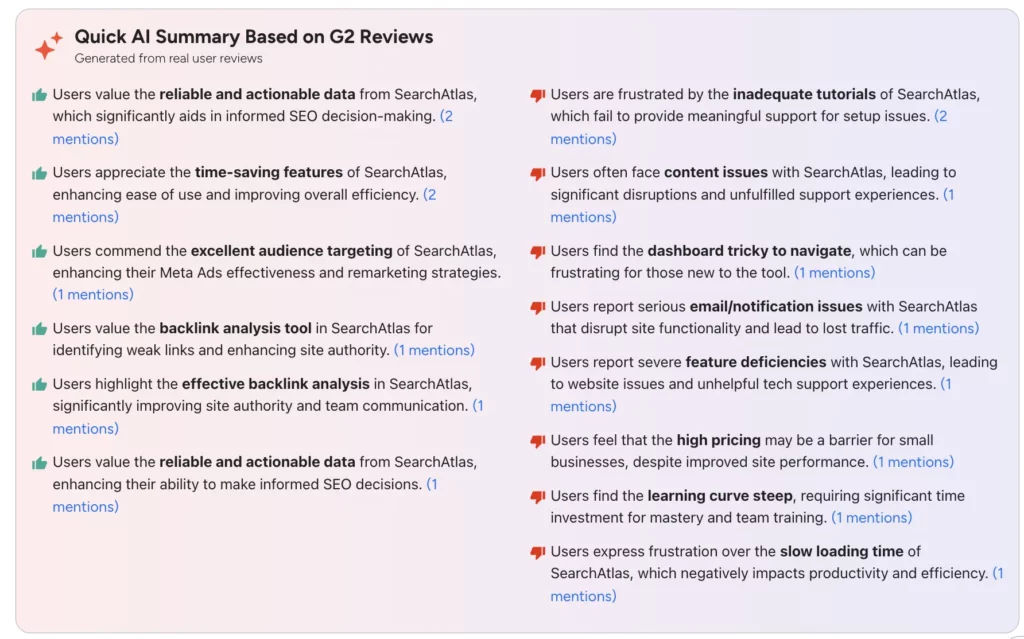
I’ve also taken a look at Search Atlas testimonials on G2 — The feedback is mixed.
Former and current Search Atlas users mention that customer support is slow, and the tool occasionally glitches.
Although I haven’t dealt with the support team personally, I have experienced some glitches as well. I also remember waiting for a few minutes to get the reports generated. Since users mention these issues pretty much everywhere on the web, I assume the Search Atlas team is aware of them and is working on fixing them.
By the way, did you know the G2 review platform creates AI summaries from user testimonials? Here’s what it looks like for Search Atlas.
3. Ahrefs
- Best for: SEO agencies, mid-size businesses, and enterprises.
- Best features: AI Content Helper, Brand Radar, Rank Tracker, and Keyword Explorer.
- Pricing: Starts at $129/month for the Lite plan. The annual subscription gives you 2 months for free.
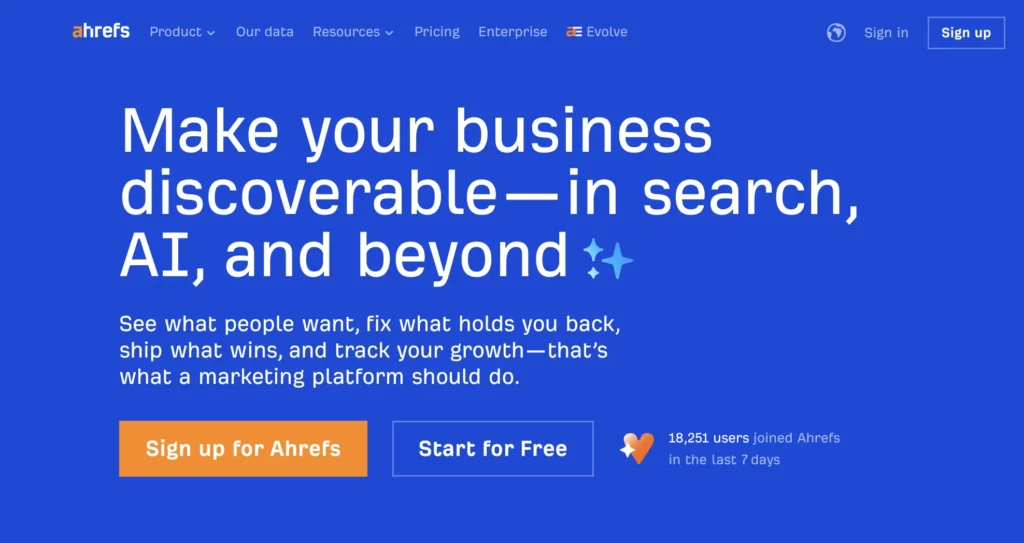
Ahrefs was actually the very first SEO tool I started using way back in 2015. The interface pretty much looks the same today, but the number of features has grown a lot since then.
They’ve also added a bunch of AI SEO features and updated their key promise to “Make your business discoverable in search, AI, and beyond.”
Over the years, Ahrefs has been my go-to SEO tool for various tasks, including:
- Doing keyword research
- Tracking how my site’s rankings change over time
- Tracking the performance of new pages and the ones that were recently updated
- Finding technical issues on my site
- Checking competitors’ top pages
- Monitoring new and lost backlinks
- …and honestly, so much more.
It’s worth mentioning that I paused my Ahrefs subscription in July 2025 since I’ve noticed that Ahrefs’ performance data doesn’t align with reality. They still have this issue, though, so keep this in mind when relying on their data.
For example, Ahrefs’ Site Explorer report shows that my website gets over 44,000 organic visits per month. I’d be glad to have this traffic, but in reality, my site gets around 15,000 monthly visitors from all marketing channels.
In my opinion, Ahrefs also overestimates the organic traffic of individual pages and keyword metrics.
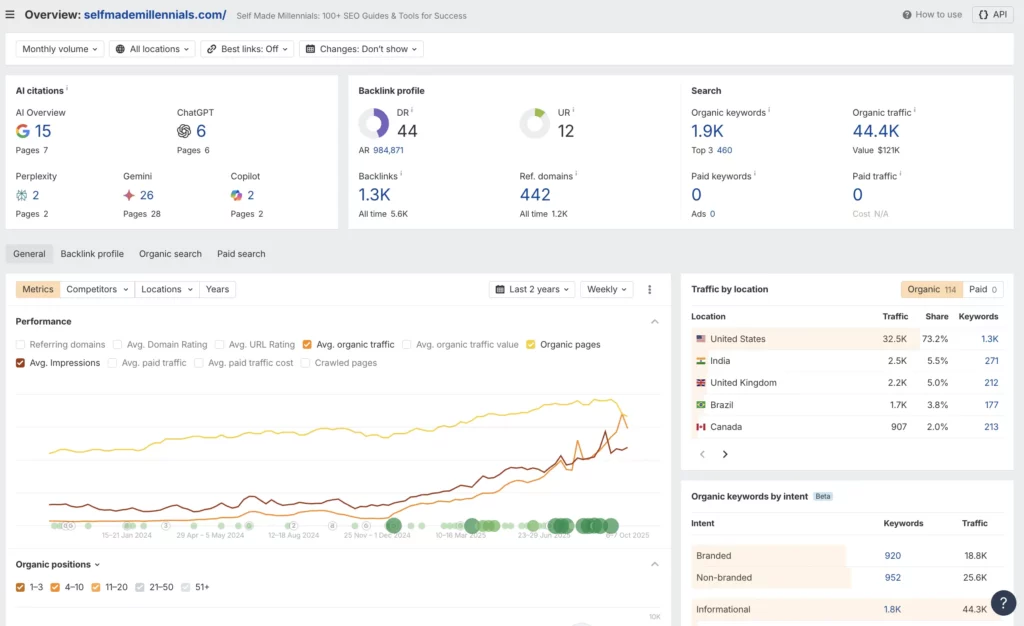
Here’s how Ahrefs and SE Ranking compare based on my website’s performance data from September 2025:
| Category | Ahrefs | SE Ranking | Google Search Console |
|---|---|---|---|
| Organic traffic | 40.4k | 3.3k | 8.45k |
| Top 3 pages based on organic traffic | AI SEO tools Ahrefs alternatives AI marketing tools | AI SEO tools Ahrefs alternatives AI marketing tools | AI SEO tools AI marketing tools Ahrefs alternatives |
| Organic traffic estimate for the top-ranking page | 14.87k | 1.15k | 3.73k |
| Number of keywords | 1.9k | 7.4k | |
| Referring domains | 442 | 612 | |
| Number of backlinks | 1.3k | 2k |
It’s kind of funny when you think that we’re comparing two tools where one shows inflated numbers, and the other does the complete opposite, underreporting my website’s performance.
These days, I don’t really trust most SEO tools for their metrics. Instead, I examine trends, such as how the traffic chart changes to determine if a website gains or loses traction. It’s a much safer approach because otherwise, your clients might be shocked when the numbers don’t match what they see in GA or GSC.
What’s the difference between Ahrefs and SE Ranking?
Let me share my personal take on this.
Both Ahrefs and SE Ranking come with solid SEO toolkits, so you can easily handle most SEO tasks with either one.
However, SE Ranking is more affordable. Its basic plan starts at $65/month for one user, five projects, and 500 tracked keywords per day. But you don’t get on-page or SERP analysis, and the AI tools aren’t included in the cheapest plan. So, your experience will feel limited. To get full access, you’ll likely need to upgrade to the Pro plan, which costs $199/month, which is not that far from Ahrefs’ Lite plan at $129/month.
From my experience, Ahrefs tends to overestimate keyword and traffic metrics, while SE Ranking usually underestimates keyword and traffic metrics. If you skipped the comparison table above, I recommend checking it. It really shows this difference.
SE Ranking isn’t just an SEO tool. Your marketing team can use it for content ideas, social media, and even local SEO tasks.
But if your main focus is SEO, Ahrefs is still a top choice. I’d suggest starting with Ahrefs’ free Webmaster Tools if you have a verified domain. It’s a great way to test it out before committing. Honestly, I’m confident Ahrefs can cover most, if not all, of your SEO needs.
4. Writesonic
- Best for: Content marketers, Content writers, small and mid-size businesses, SEOs.
- Best features: SEO Checker and Optimizer, Humanizer, Botsonic to create chatbots for your website.
- Pricing: Starts at $49 per month per user seat and one project. 7-day free trial, no credit card required. There’s also a free plan.
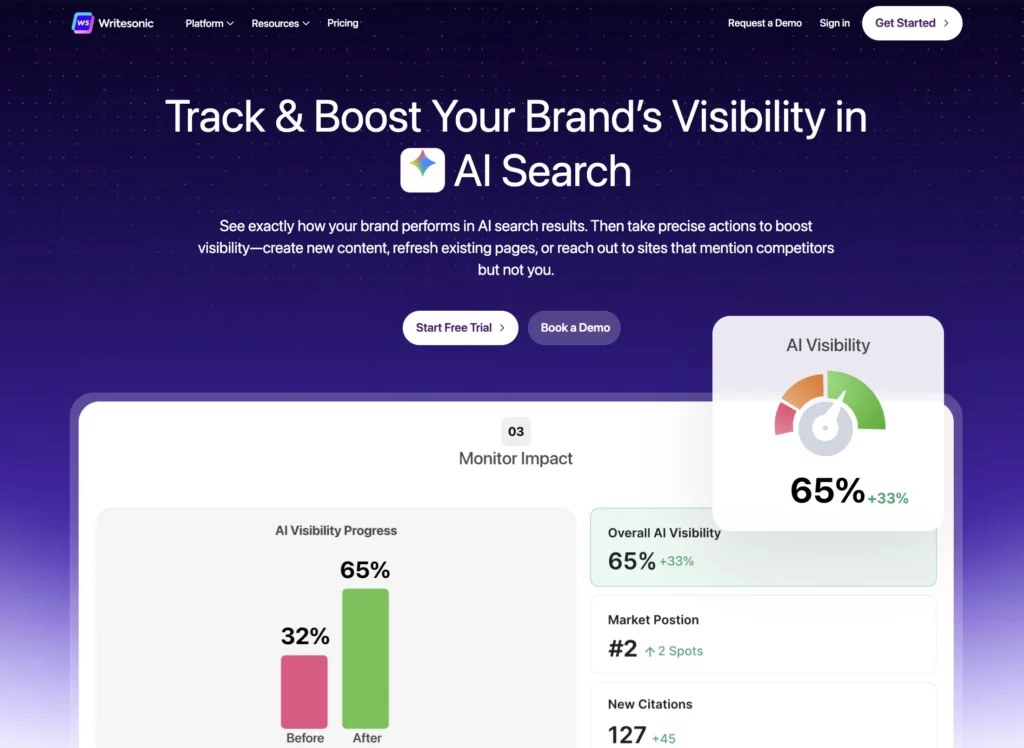
Writesonic is an SEO tool powered by AI that I call a solid alternative to SE Ranking’s Content Marketing Toolkit.
In a nutshell, Writesonic aims to help you with researching topics, writing and editing content, publishing it automatically, and tracking how it performs.
However, it’s not purely a content writing tool for SEO. It offers multiple SEO features for users. Here’s a brief summary:
Conduct keyword research: You can find keywords with ranking potential, discover what your audience is searching for, and group related topics into clusters using three dedicated research tools.
Create content for your site: You can use the AI Article Writer 6.0, article rewriter, or templates for blog posts and social content. You can also create outlines, briefs, and long-form posts (up to 5,000 words), such as how-to guides or listicles.
Write in your own voice: If you want the AI to sound like you, upload some of your writing. Writesonic will analyze your tone and style so the new content matches your voice.
Optimize your content for ranking: Writesonic includes an AI SEO checker, similar to Semrush’s Content Toolkit (formerly ContentShake AI) or Ahrefs’ Content Helper, that evaluates how well your content is optimized for rankings. It can also perform a content gap analysis, identify missing topics, and automatically add internal links.
Automatically publish your content: You can publish directly to WordPress or other platforms without leaving Writesonic.
Repurpose your content: You can turn blog posts into newsletters or social media updates using built-in templates. The “Humanizer” feature helps make AI-generated content sound more natural.
Audit your site: You’ll get a report with a detailed analysis of your website performance with insights about your website’s indexability status, content quality, security issues (such as if HTTPS protocols are present), international SEO analysis (mainly missing hreflang tags), broken links, and other technical SEO issues.
Track your website performance: You can connect your GSC account to monitor your site’s performance regularly, including top pages, top keywords, top keyword and pages changes, and more.
Track your site’s presence in AI search results: Writesonic has a feature called “GEO,” which lets you monitor your brand’s ranking across all AI platforms and track competitive positioning.
Despite the tool being relatively new to the market, it offers quite a few helpful features to be called a solid SE Ranking alternative.
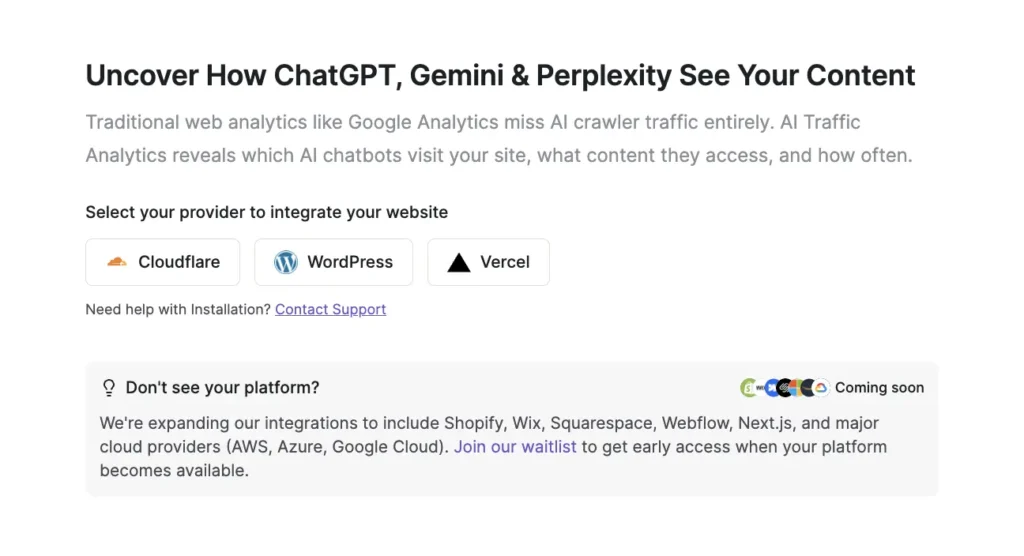
Note that Writesonic isn’t the tool for competitive analysis! So, if that’s what you’re after, I’d recommend checking out the tools I mentioned earlier. It does have a Keyword Gap feature, but that’s pretty much where it ends. You won’t be able to dig into your competitors’ organic performance or see which keywords are driving their traffic.
Its keyword research tool is quite handy if that’s your main focus.
Here’s a closer look at Writesonic’s keyword metrics compared to SE Ranking for the “AI SEO tools” keyword (USA data, October 2025).
| Category | Writesonic | SE Ranking |
|---|---|---|
| Search volume | 2,400/month | 40/month |
| Keyword difficulty | 80/100 – competitive keyword | 25/100 – easy to rank keyword |
| Search intent | Informational | Informational |
| Cost per click | $1.95 | $7.92 |
| Traffic potential | 7,700 | N/a |
Since my website ranks #1 for this keyword, I know some performance insights that no one else has. For example, I know that this keyword has a transactional search intent since users tend to purchase tool subscriptions.
I also know that this is a very competitive keyword since many companies, including the established ones, want to get to the top 3 search results.
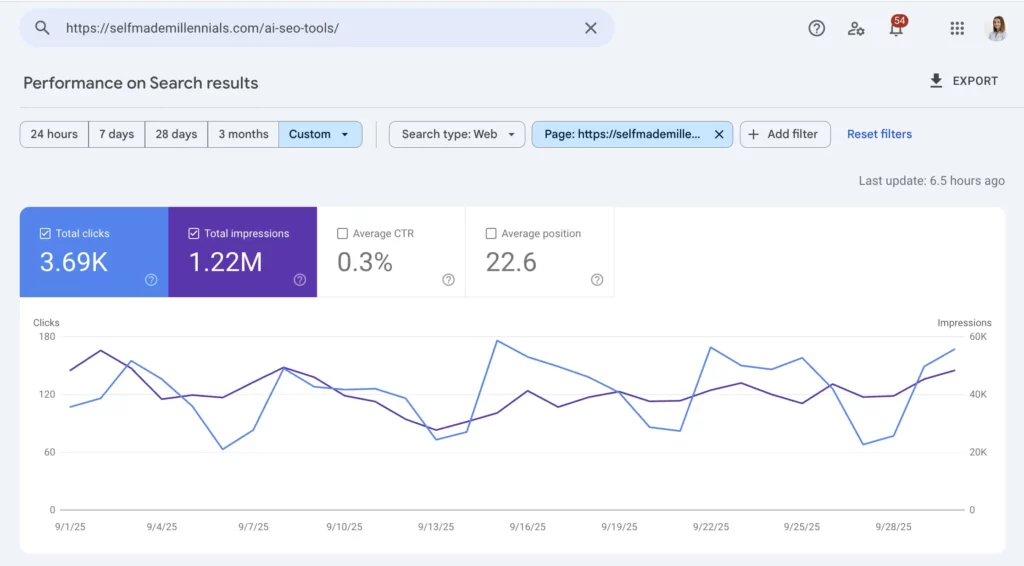
I can also say that SE Ranking’s organic traffic estimates are off. Here’s how much organic traffic my AI SEO tools post generated in September.
Out of the total traffic, I’ve got 7,651 impressions and 152 clicks from the “AI SEO tools” keyword alone.
Is SE Ranking still worth using?
Honestly, yes — SE Ranking is still a pretty solid SEO tool.
It covers all the basics you’d expect: keyword research, rank tracking, backlink analysis, and site audits.
It’s also more budget-friendly compared to many other all-in-one SEO tools. Just keep in mind that the cheapest plan has some limitations, meaning that the full feature set is available with the Pro plan, which costs $199/month.
If you’ve used Semrush before, you’ll probably notice some similarities in the interface. Both tools offer multiple toolkits for different marketing needs. But unlike Semrush, SE Ranking includes all its toolkits and features under the same pricing plans. So whether you’re on the Essential or Business plan, you’ll get access to everything, which, honestly, is a big plus since Semrush charges extra for each toolkit.
SE Ranking’s data and metrics aren’t always 100% accurate. Still, it’s great for spotting trends. You can see whether your competitors are growing or dropping, track your own keyword rankings, monitor your site’s overall performance, and many other things.
If you’ve used SE Ranking, what has been your experience?

Join the newsletter for actionable SEO tips, case studies, and a behind-the-scenes look at my affiliate marketing journey.
No spam. Unsubscribe anytime.